
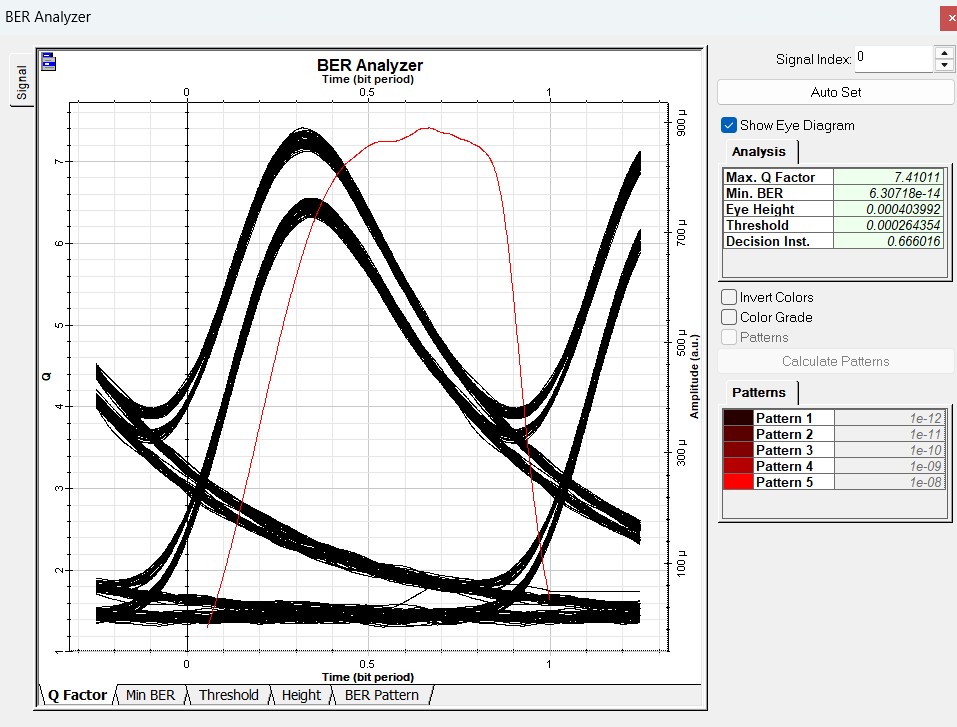
Wavelength Shift Keying (WSK) is a digital optical modulation technique in which information is transmitted by switching the optical carrier between two or more discrete wavelengths.
Instead of varying the amplitude, phase, or frequency of a single carrier, WSK encodes data by selecting different optical wavelengths (or colors of light) to represent different symbols.
How It Works
Binary WSK (BWSK): Two wavelengths are used — one represents a binary “0” and the other represents a binary “1”.
M-ary WSK (M-WSK): More than two wavelengths are used, where each wavelength represents a unique symbol, allowing transmission of multiple bits per symbol.
The transmitter can use tunable lasers or optical filters to generate/select the desired wavelengths.
At the receiver, a wavelength-selective filter (such as an optical demultiplexer) directs each wavelength to its respective photodetector.
Advantages
- Immunity to amplitude noise — since data is encoded in wavelength rather than power levels.
- Compatibility with WDM systems — WSK symbols can coexist with other wavelength channels.
- High spectral efficiency when implemented in M-ary form.
Limitations
- Complexity in tunable sources — requires fast and stable wavelength switching.
- Wavelength drift sensitivity — precise stabilization is needed to avoid symbol errors.
Applications in Optical Communication
WSK is often used in:
Specialized free-space optical links — where atmospheric turbulence has less impact on wavelength stability than on amplitude or phase.
Optical label switching — attaching a short “label” to packets in optical networks for routing decisions.
Multi-wavelength optical networks — where each symbol corresponds to a distinct channel.