In optical communication systems, wavelength selection is a fundamental design decision rather than a secondary consideration. It directly influences dispersion characteristics, amplification methods, transmission reach, spectral efficiency, and ultimately the scalability and cost-effectiveness of the network. The standard optical bands—O, E, S, C, and L—are each defined by distinct physical properties and system-level trade-offs.
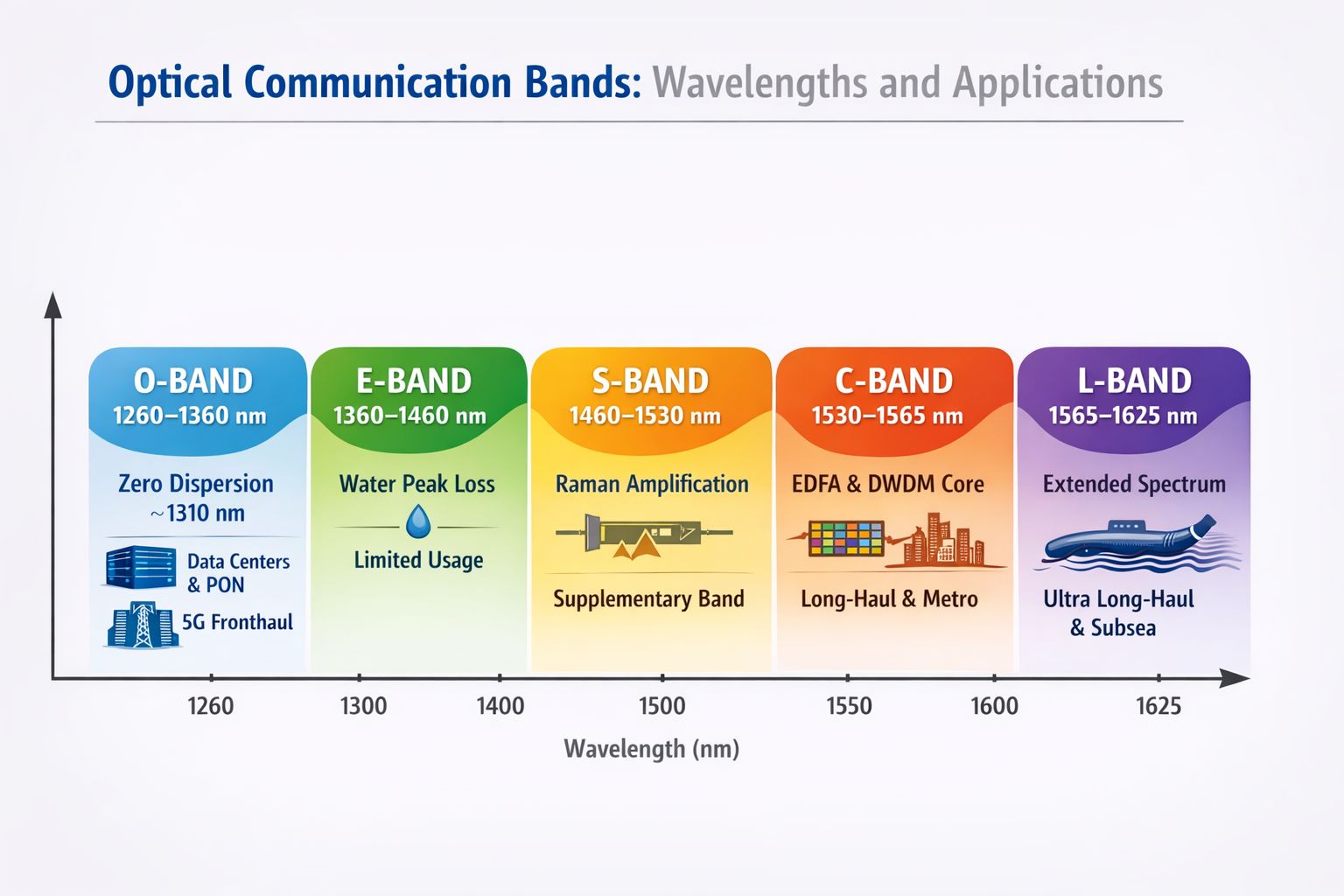
The O-band (1260–1360 nm) operates near the zero-dispersion point of standard single-mode fiber, around 1310 nm. This significantly reduces chromatic dispersion without requiring compensation, making it well-suited for short-distance and latency-sensitive applications where optical amplification is not needed. Consequently, the O-band is widely used in data center interconnects, passive optical networks (PON), and mobile fronthaul systems, where stability and power efficiency are key priorities.
The E-band (1360–1460 nm) has historically been limited by high attenuation caused by the water absorption peak in optical fibers. Although advancements in low-water-peak fiber technology have mitigated this issue, the lack of a well-established amplification ecosystem has restricted its widespread adoption, leaving it with limited practical deployment.
The S-band (1460–1530 nm) occupies an intermediate position between access and long-haul transmission bands. It can be supported using Raman amplification and has been investigated as a means of extending system capacity, particularly in specialized long-haul and subsea applications. However, its overall ecosystem remains less mature compared to more established bands.
The C-band (1530–1565 nm) serves as the core of modern optical communication networks. It aligns well with erbium-doped fiber amplifier (EDFA) technology, offers low transmission loss, and supports dense wavelength division multiplexing (DWDM). As a result, it underpins most contemporary coherent transmission systems, ranging from 100G to 800G, and is extensively used in metro, core, and long-haul networks.
The L-band (1565–1625 nm) extends the available optical spectrum beyond the C-band, enabling additional capacity without the need for new fiber deployment. Although it experiences slightly higher attenuation and requires more complex amplification, it plays a crucial role in ultra-long-haul and subsea systems where fiber resources are limited. Combined C+L band operation has become a standard approach for achieving high-capacity transmission in next-generation networks.
From a system architecture perspective, access networks and data centers typically prioritize the simplicity of the O-band, while metro and core networks rely on the efficiency of the C-band. Subsea and ultra-long-haul systems increasingly utilize combined C+L band strategies to maximize capacity. As global data demand continues to rise, particularly with the expansion of AI-driven infrastructure, wavelength selection is emerging as a primary factor shaping network performance, energy efficiency, and long-term economic viability.