
Imagine you have a pair of “magic” socks. You put one on your left foot in New York and send the other to a friend in Tokyo. Here is the magic: the moment you pull your sock on and see it is Blue, your friend’s sock—which was a blurry, shifting rainbow of colors just a second ago—instantly turns Red.
There was no phone call, no signal, and no delay. The two socks acted as a single unit across the ocean. This is the essence of Quantum Entanglement. Albert Einstein famously called it “spooky action at a distance,” and while it sounds like science fiction, it is the cornerstone of the next technological revolution.
In the world of Photonics, we create this “spooky” connection using particles of light.
How to “Birth” Entangled Photons
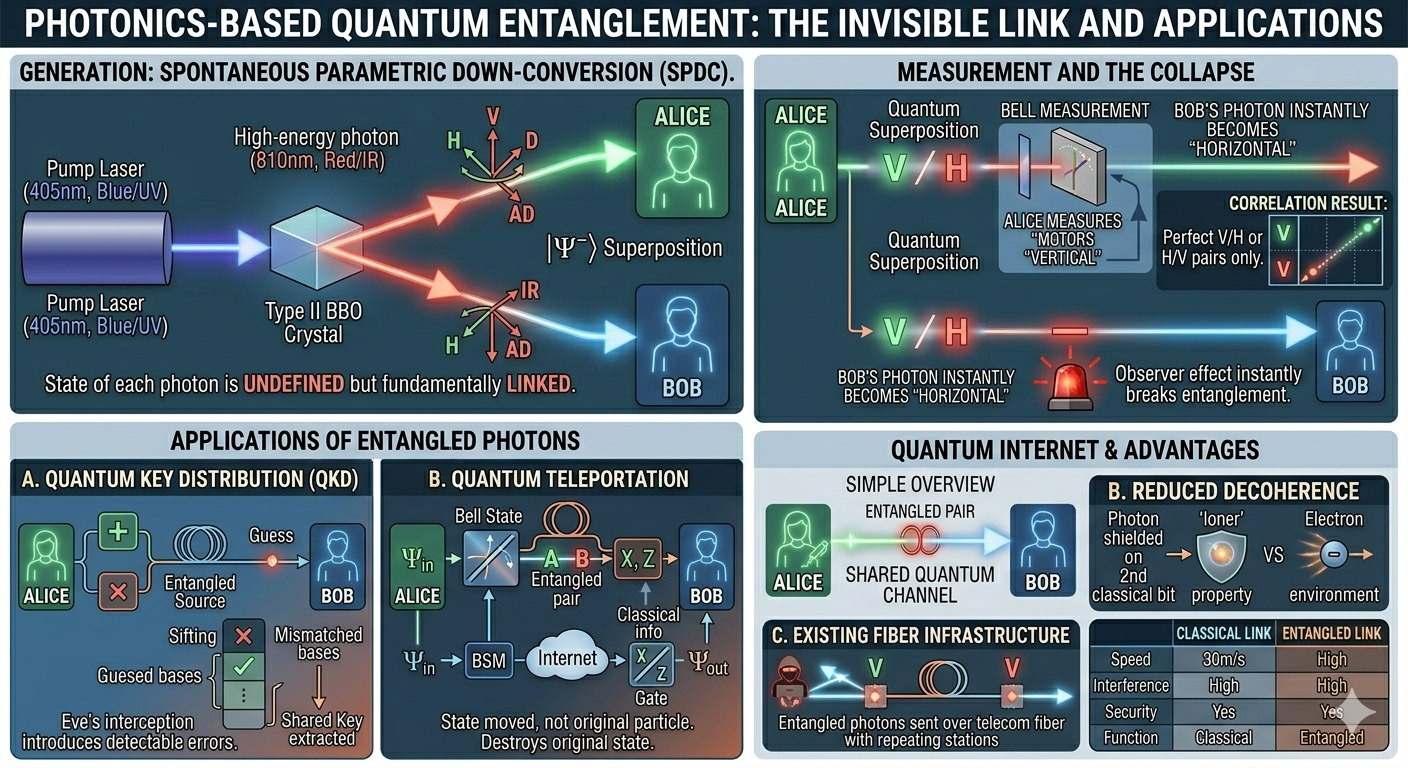
In a lab, we don’t use socks; we use a special kind of crystal (like Beta Barium Borate, or BBO). The process is called Spontaneous Parametric Down-Conversion (SPDC).
- The Pump: We fire a high-energy “pump” laser (usually blue or UV light) into the crystal.
- The Split: Occasionally, a single high-energy photon interacts with the crystal’s atoms and splits into two lower-energy photons.
- The Link: Because these two “daughter” photons were born from the same parent at the exact same moment, they are fundamentally linked. Their properties (like polarization or momentum) are tied together by the law of conservation of energy.
The result? If Photon A is vibrating vertically, Photon B must be vibrating horizontally. But here is the catch: until you actually look at them, neither photon has a set direction. They exist in a superposition of all possibilities at once.
The “Spooky” Connection: Why It’s Unique
You might think, “Maybe they were just pre-programmed to be that way?” Like two envelopes with “Heads” and “Tails” written inside?
Bell’s Theorem, a famous physics proof, showed that this isn’t the case. Quantum particles don’t have a “hidden” plan. The choice of which state they take happens at the moment of measurement.
When we use photonics to measure Photon A, the “wavefunction” collapses. Photon A “picks” a state, and Photon B instantly “picks” the corresponding state to match its partner. This happens faster than the speed of light—though, sadly for sci-fi fans, we can’t use this to send text messages faster than light because the results are still random!
Why Use Light (Photonics) for Entanglement?
There are many ways to entangle things (atoms, ions, superconducting loops), but Photons are the undisputed champions for communication:
- Speed: They travel at the ultimate speed limit of the universe.
- Low Interference (Decoherence): Photons are “loners.” They don’t have an electric charge, so they don’t get distracted by magnetic fields or heat as easily as electrons do. This allows them to stay entangled over hundreds of miles.
- Infrastructure: We already have a global network of fiber-optic cables. We can “ride” the existing internet infrastructure to send entangled states across cities.
What Can We Do With It?
Entanglement isn’t just a party trick; it’s a tool for three major future technologies:
1. Quantum Teleportation
No, we aren’t beaming people up yet. Quantum teleportation is the process of moving the information (the quantum state) of one particle to another distant particle using entanglement as a bridge. The original state is destroyed, and an exact replica appears at the destination.
2. The Quantum Internet
By linking quantum computers via entangled photons, we can create a “super-brain” of computers. This would allow for distributed computing power that dwarfs anything currently on Earth.
3. Super-Dense Coding
Entanglement allows us to “overlap” information. In a classical system, one photon carries one bit (0 or 1). With entanglement, we can use the relationship between two photons to send significantly more data than should be physically possible.
Summary: Classical vs. Entangled Links
| Feature | Classical Correlation | Quantum Entanglement |
| Connection | Predetermined (Envelopes) | Spontaneous (Superposition) |
| Distance | Limited by signal speed | Instantaneous “link” (though no FTL info) |
| Security | Can be copied/read | “Breaks” if someone tries to peek |
| Medium | Voltage/Light pulses | Entangled Photon Pairs |
Photonics-based entanglement is essentially the “wiring” for a future where distance no longer limits how particles coordinate. It’s the ultimate proof that the universe is far more interconnected—and far weirder—than we ever imagined.