
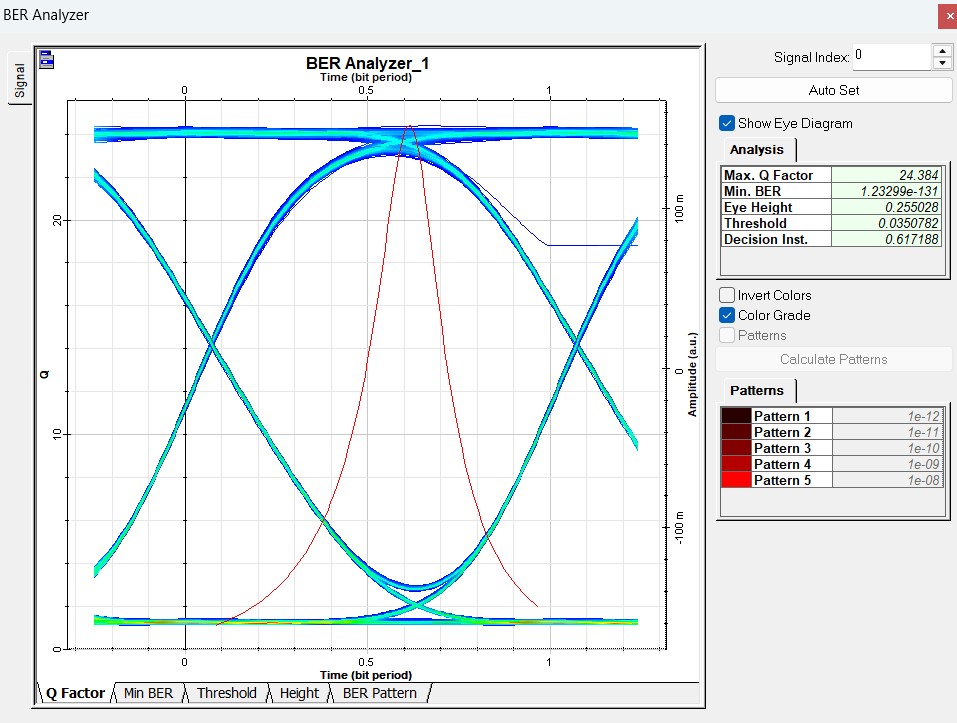
Wavelength Shift Keying (WSK) is a digital optical modulation technique in which information is transmitted by switching the optical carrier between two or more discrete wavelengths.
Instead of varying the amplitude, phase, or frequency of a single carrier, WSK encodes data by selecting different optical wavelengths (or colors of light) to represent different symbols.
Single Laser based Wavelength Shift Keying
Generally, two different laser sources are required to generate a WSK signal. In the Optisystem design implemented here, a single laser source based WSK is implemented.
The design presented here is based on the technique proposed in the following journal paper:
https://iopscience.iop.org/article/10.1088/1402-4896/ad8e94/meta
Applications in Optical Communication
WSK is often used in:
Specialized free-space optical links — where atmospheric turbulence has less impact on wavelength stability than on amplitude or phase.
Optical label switching — attaching a short “label” to packets in optical networks for routing decisions.
Multi-wavelength optical networks — where each symbol corresponds to a distinct channel.