
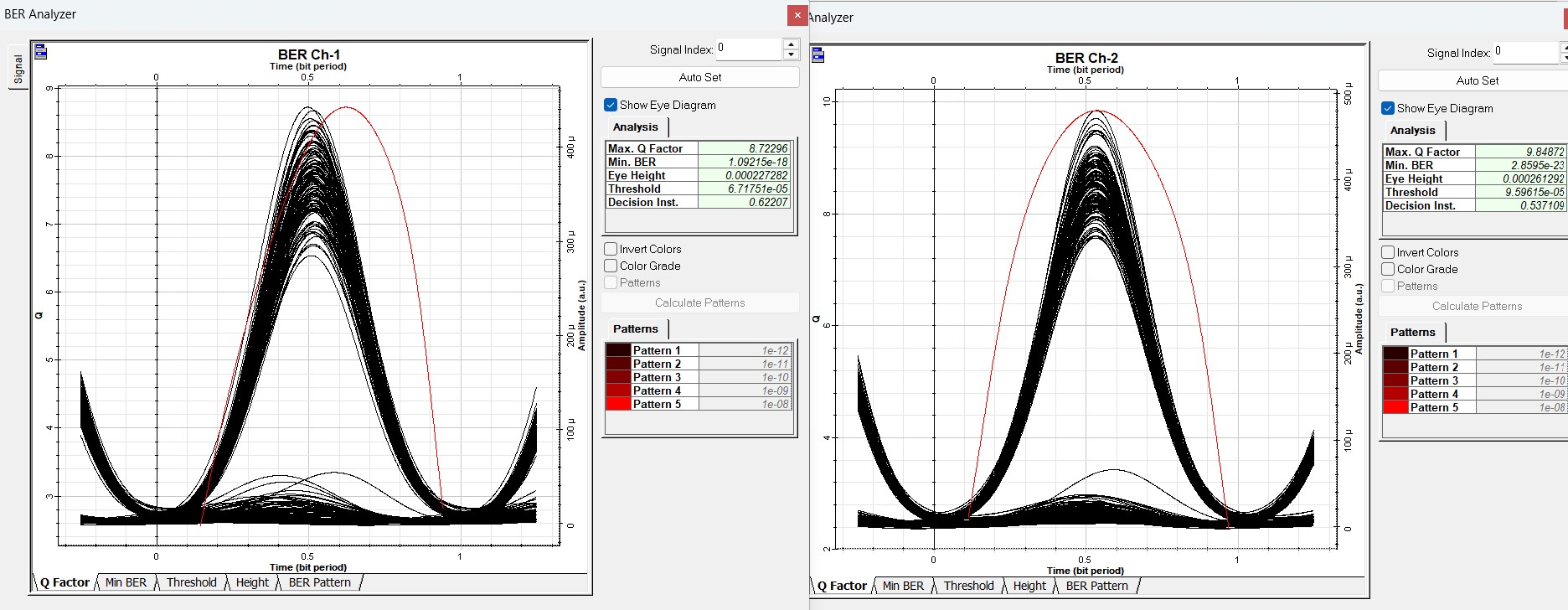
Optical Pulse Position Modulation (PPM) is a digital modulation technique where information is encoded in the temporal position of an optical pulse within a predefined time frame (or slot). Instead of varying amplitude, phase, or frequency, PPM conveys data by shifting the pulse location in time.
How It Works
The transmission time is divided into equal time slots.
Within each symbol period, exactly one optical pulse is transmitted, and its position within the slots represents the data.
For example:
2-PPM (binary PPM): Two possible slots → pulse in slot 1 = bit “0”, pulse in slot 2 = bit “1”.
M-PPM: With M slots, each symbol carries log2M bits of information.
Advantages
- High energy efficiency — all transmitted energy is concentrated in a single pulse, improving sensitivity in photon-limited environments.
- Excellent for free-space optical (FSO) links — strong performance under background noise and turbulence.
- Simple receiver implementation — typically requires only a time-resolved photodetector.
Challenges
- Large bandwidth requirement — narrower pulses are needed for higher-order PPM, increasing spectral usage.
- Synchronization sensitivity — precise timing alignment is critical.
- Lower spectral efficiency — compared to phase or amplitude modulation schemes.
Applications in Optical Communication
PPM is particularly useful in scenarios where power efficiency is more critical than bandwidth efficiency, such as:
Low-power optical wireless communication (e.g., indoor optical links, Li-Fi research).
Deep-space optical communication (NASA, ESA missions)
Satellite-to-ground free-space optical (FSO) links
Quantum key distribution (QKD) systems