
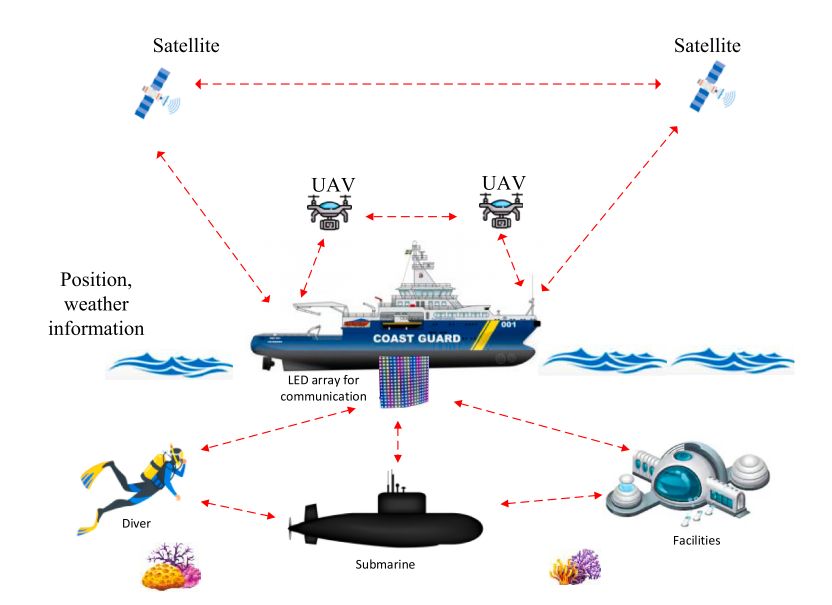
Optical Wireless Communication (OWC) is emerging as a key technology for next-generation connectivity in 6G and future networks. As the radio frequency (RF) spectrum becomes increasingly congested—particularly below 40 GHz due to the rapid growth of connected devices—OWC offers an alternative approach by using visible light (VL), infrared (IR), and ultraviolet (UV) wavelengths as transmission media.
Compared to conventional RF systems, light-based communication provides several major advantages. It offers extremely large bandwidth, potentially up to 1000 times greater than RF. It is inherently immune to electromagnetic interference (EMI), supports high-security communication through narrow line-of-sight beams, and can be deployed cost-effectively by leveraging existing infrastructure such as LEDs, laser diodes, and imaging sensors.
OWC encompasses several key technologies. Visible Light Communication (VLC) utilizes LED or laser sources to simultaneously provide illumination and data transmission. Light Fidelity (LiFi) serves as an optical counterpart to WiFi, enabling high-speed indoor wireless connectivity. Optical Camera Communication (OCC) employs LED transmitters and camera-based receivers, making it suitable for outdoor and mobility-focused applications. Free-Space Optical (FSO) communication uses highly directional laser beams to achieve long-distance, high-capacity links, including inter-satellite communication.
The application landscape of OWC in 6G and beyond is extensive. In drone communication, optical links can support secure and interference-free connectivity for delivery, surveillance, and defense UAVs. In satellite networks, FSO enables ultra-high-speed satellite-to-satellite and satellite-to-ground links, potentially reaching terabit-per-second capacities. Underwater communication systems can use optical signals for marine exploration, offshore operations, and defense applications. Vehicular networks (V2V and V2I) can leverage OCC techniques, such as rolling shutter-based reception, to enable short-range communication between vehicles. In smart cities, VLC and LiFi integrated into streetlights and infrastructure can provide high-speed public connectivity.
OWC offers several compelling advantages for future networks. It is highly scalable, as it can utilize existing lighting and imaging infrastructure such as streetlights, cameras, and displays. It is also adaptable, complementing RF systems in hybrid architectures where optical links can maintain performance in RF-degraded environments. In terms of performance, OWC supports extremely high data rates and ultra-low latency, making it suitable for real-time applications such as autonomous systems, remote sensing, and immersive AR/VR experiences.
As 6G networks evolve toward ultra-dense and ultra-fast communication systems, OWC is expected to play a crucial role not only as a complement to RF technologies but as a foundational enabler of future global connectivity.