
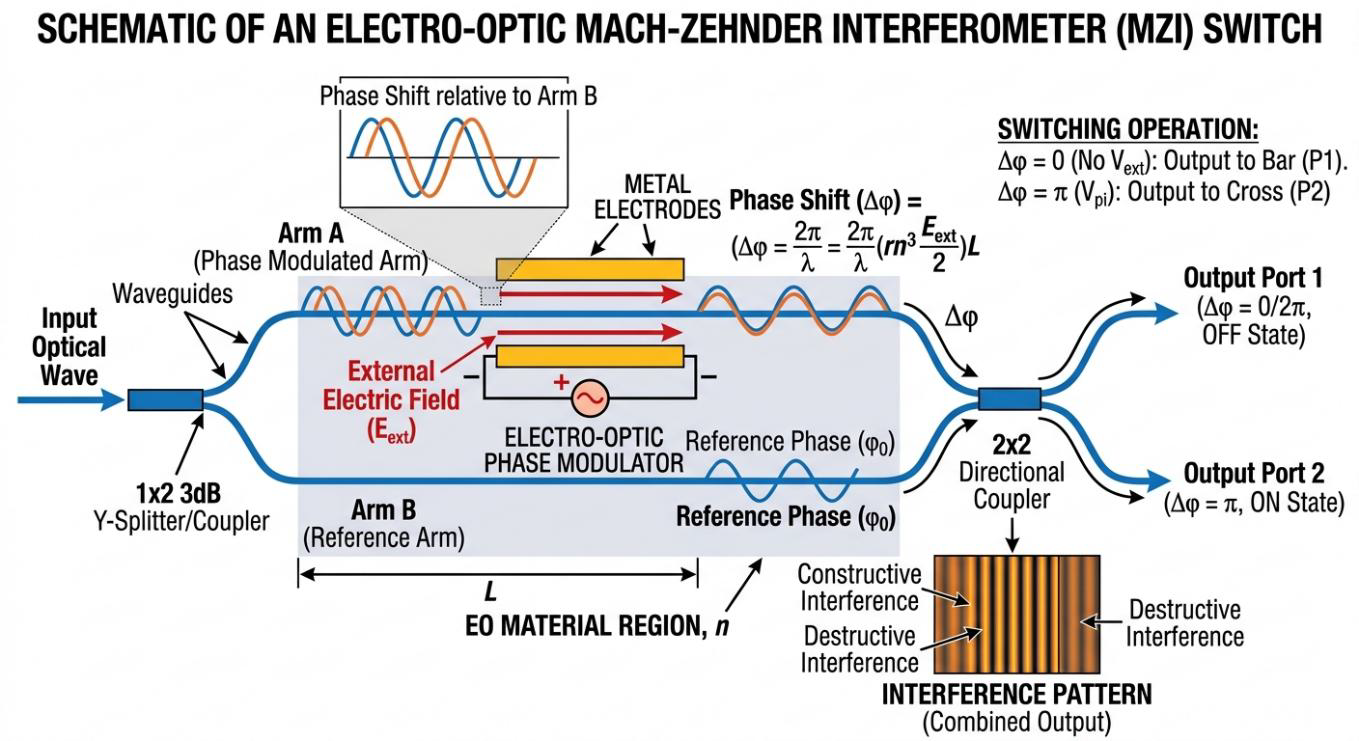
Light moves through certain pathways built into devices that handle data using photons instead of electrons. What happens inside one common setup – the Mach-Zehnder Interferometer – is explained here through deep physics rooted in electric and magnetic fields. Waves travel along paths shaped by materials that respond when voltage is applied, thanks to a property found in crystals like lithium niobate. Boundaries between different parts force light to shift phase depending on external signals. When beams recombine, their overlap decides whether output turns bright or dark. Math spells out exactly how much voltage flips the state, known as Vπ, based on material traits and structure size. Calculations shown match real-world performance of such switches made from LiNbO₃. From basic laws laid down long ago to today’s fast optical circuits – this shows how tightly they’re tied together.
With rising needs across fiber systems, data hubs, and light-based computation, the optical switch now holds key importance in today’s communication setups. Light paths shift without converting to electricity – instead, these devices guide photons using insulating channels that shape how waves travel. Direction changes happen through material responses where beams move between routes based on controlled shifts in refractive behavior.
Light moves through a channel because of how electric and magnetic fields behave. What happens inside that path follows rules pulled straight from Maxwell’s math, held in place when light bounces cleanly across inner surfaces. Voltage added from outside via tiny built-in contacts shifts the material’s ability to slow down light – its refractive index – altering how fast waves travel within it instead. Such changes affect how peaks and troughs line up where paths merge later, nudging outcomes toward either buildup or cancellation simply. That shift in alignment behavior captures what optical switching actually relies on beneath the surface.
The Mach-Zehnder Interferometer (MZI) Optical Switch
A light-based switch called the Mach-Zehnder Interferometer is commonly found inside gear that handles data at speeds from 100 to 400 gigabits per second. This piece works by using electric signals to guide photons along paths in systems where multiple wavelengths travel together. Instead of bulky parts, it fits neatly into tiny chips designed for moving information with light. Because of how precisely it controls beams, engineers rely on it within advanced setups meant for high-capacity links
Beamforming setups inside phased-array antennae alongside quantum light-based chips shape how signals move. This kind of setup includes parts that guide energy in precise directions. Built into the structure are components handling both wave control and photon manipulation. Elements work together through timing shifts and optical pathways. Arrangement allows coordination between radio frequency systems and photonic circuits
One single-mode optical path feeds in. From there, a Y-shaped splitter cuts the light into equal parts across two routes. Each route holds a modulator arm, built with electric segments and layered electrodes. These paths later meet again at another Y-junction, merging the split waves. The result shows up at exits where brightness shifts based on timing gaps formed along the separate lanes.
Voltage changes tweak the material’s response through the Pockels effect, shifting how light moves inside. That shift builds up into a precise phase difference, step by step. Light travels in one mode only because boundaries between core and cladding lock out others. This single path isn’t optional – it’s needed for clean wave overlap later. What guides the shape of the light field and its speed down the line? Maxwell’s equations do that job. A new version of D, shaped by ε and χ under electric nudges, ties static voltage straight to adjustments in β. From start to finish, each piece maps clearly onto the next. When waves overlap, their combined effect follows simple addition rules from Maxwell’s equations, leading to intensity given by I = I cos²(/2). Every stage in how the device works fits within standard electromagnetic theory.
MZI-driven optical switches see heavy use across several advanced systems. Starting with high-speed networks – like those handling 100G through 800G traffic – they shape QAM waveforms using coordinated tweaks in both signal strength and timing. Instead of separate components, one compact device manages dual control tasks. On photonic chips built from materials such as lithium niobate or indium phosphide, these devices guide light paths inside massive server hubs. Their role becomes critical when rerouting signals without converting them back to electrical form. Another area gaining traction involves blending such structures into larger optical setups where precision matters most
Starting with light-bending setups in radar-like sensors, networks of tiny MZI gates tweak timing across emitter points. Next up: quantum chips that shuffle photon bits using grids of these same MZI links to handle complex math steps. Every case leans on one core idea – steering waves by adjusting travel routes through electric nudges that alter beta differences