
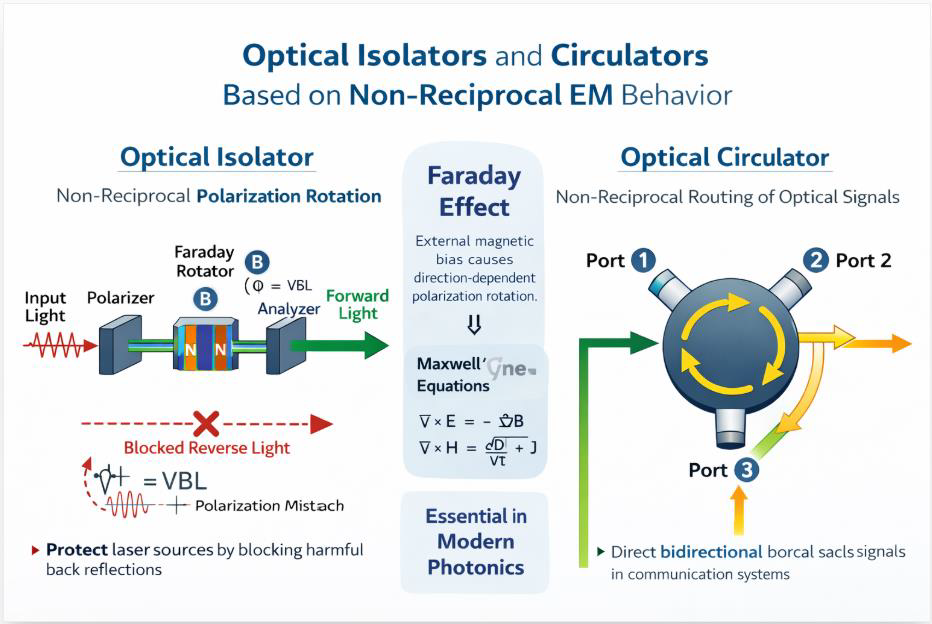
Optical communication systems rely on the guided transmission of electromagnetic (EM) waves to facilitate robust information exchange. The presence of spurious reflections and reflected signals can compromise system performance and potentially damage sensitive components, particularly laser sources. Optical isolators and circulators serve to mitigate these unwanted reflections by constraining light propagation to a single direction. These devices operate on the principle of non-reciprocal EM behavior, where the characteristics of wave propagation exhibit dependence on the direction of travel. This section will delineate the electromagnetic principles underpinning the operation of isolators and circulators and discuss selected applications.
A fundamental characteristic of electromagnetic propagation is reciprocity, implying that propagation properties should remain invariant with respect to direction. However, certain materials can exhibit a loss of this inherent symmetry when subjected to an external magnetic bias. This phenomenon is termed non-reciprocity. Optical isolators and circulators are engineered leveraging the principle of non-reciprocity, primarily through the Faraday Effect. The Faraday Effect induces a rotation in the plane of polarization of an EM wave as it traverses materials possessing magneto-optic properties. The magnitude and orientation of this rotation are contingent upon the wave’s propagation direction relative to the applied external magnetic field. According to Maxwell’s equations, the propagation of electromagnetic waves within a medium is governed by the intricate relationship between the electric (E) and magnetic (H) fields within that medium. When a magnetic bias is imposed, the medium acquires directional dependence, or anisotropy. This directional property forms the foundational basis for isolator functionality.
The rotation of polarization due to the Faraday Effect is given by:
θ=VBL
Where:
θ = rotation angle
V = Verdet constant (material property)
B = magnetic field strength
L= length of the medium
The governing equations establish a direct correlation among polarization rotation, magnetic field intensity, and the optical path length within the material. Crucially, the orientation of this rotation remains invariant even upon reversal of the wave’s propagation direction; this specific characteristic is indispensable for realizing non-reciprocal behavior.
An optical isolator is used to provides passage of light in a prescribed forward direction and attenuates or blocks its passage in the reverse direction. Usually, the device has a polarizer, Faraday rotator, and analyzer. In the forward propagation path, light passes through every component with less hindrance. On the contrary, if light tries to go back, a mismatch in polarization blocks it. This functionality is essential for protecting laser sources from harmful back reflections, improving operational stability and reducing risk of damage.
Optical circulators are multi-port devices that redirect optical signals in a specified manner. A signal entering Port 1 goes to Port 2 and then to Port 3. They work in the same way by means of non-reciprocal polarization rotation. An optical signal that arrives at the designated port is directed to the next port in the prescribed sequence, thus preventing a backward flow. The directionality of circulators makes them advantageous for applications in optical networks, fiber communication, and bi-directional communication over a single fiber.
Many of the non-reciprocal devices such as optical isolators and circulators have provided a strong boost to high speed communication system and photonic integrated circuit. In contemporary optical networks (such as 5G/6G backhaul systems and large data centres), any back-reflected signal can destabilize laser sources and seriously degrade system performance. To prevent signal reflection and maintain steady performance, staff non-reciprocity is used. In addition, circulators in dense wavelength division multiplexing (WDM) systems can pass signals of different frequencies without damaging interference. Ongoing developments of chip-scale photonic systems indicate an increasing reliance on compact non-reciprocal components. Research into isolators without magnets documents how basic EMFT concepts don’t lose relevance even today.