

An optical frequency comb (OFC) is a special type of laser source that produces a spectrum consisting of a series of equally spaced, discrete optical frequencies — resembling the evenly spaced teeth of a comb when viewed on an optical spectrum analyzer.
How It Works
An OFC is typically generated using a mode-locked laser, which emits a train of ultra-short pulses at a fixed repetition rate frep. In the frequency domain, this pulse train corresponds to a set of narrow lines spaced by frep, with the entire comb offset by a frequency fceo (carrier–envelope offset). Each frequency in the comb can be expressed as:
fn=fceo+n⋅frep
where:
- n = integer line index
- fceo = carrier–envelope offset frequency
- frep = repetition rate of the laser
Key Features
- High spectral purity — each comb line is extremely narrow in linewidth.
- Ultra-broadband coverage — combs can span hundreds of terahertz, covering visible to infrared wavelengths.
- Mutual coherence — all comb lines are phase-locked to each other.
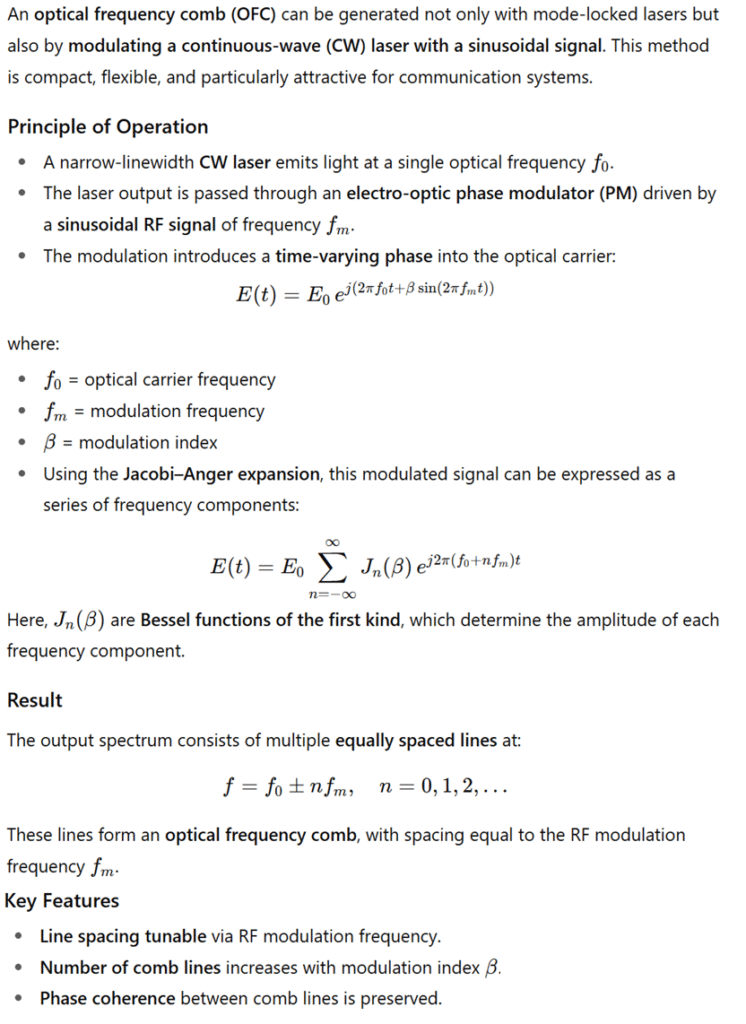
Optical Frequency Comb Generation Using Sinusoidal Modulation
Applications in Optical Communication Systems
In modern optical communication, optical frequency combs are increasingly used as multi-wavelength light sources for:
- Wavelength-division multiplexing (WDM) — providing many equally spaced carriers from a single source.
- High-capacity coherent transmission — enabling parallel data streams over multiple comb lines.
- Frequency synthesis and calibration — allowing precise mapping between optical and microwave frequencies.
By replacing multiple independent lasers with a single comb source, network complexity, power consumption, and wavelength stabilization requirements can be significantly reduced.