
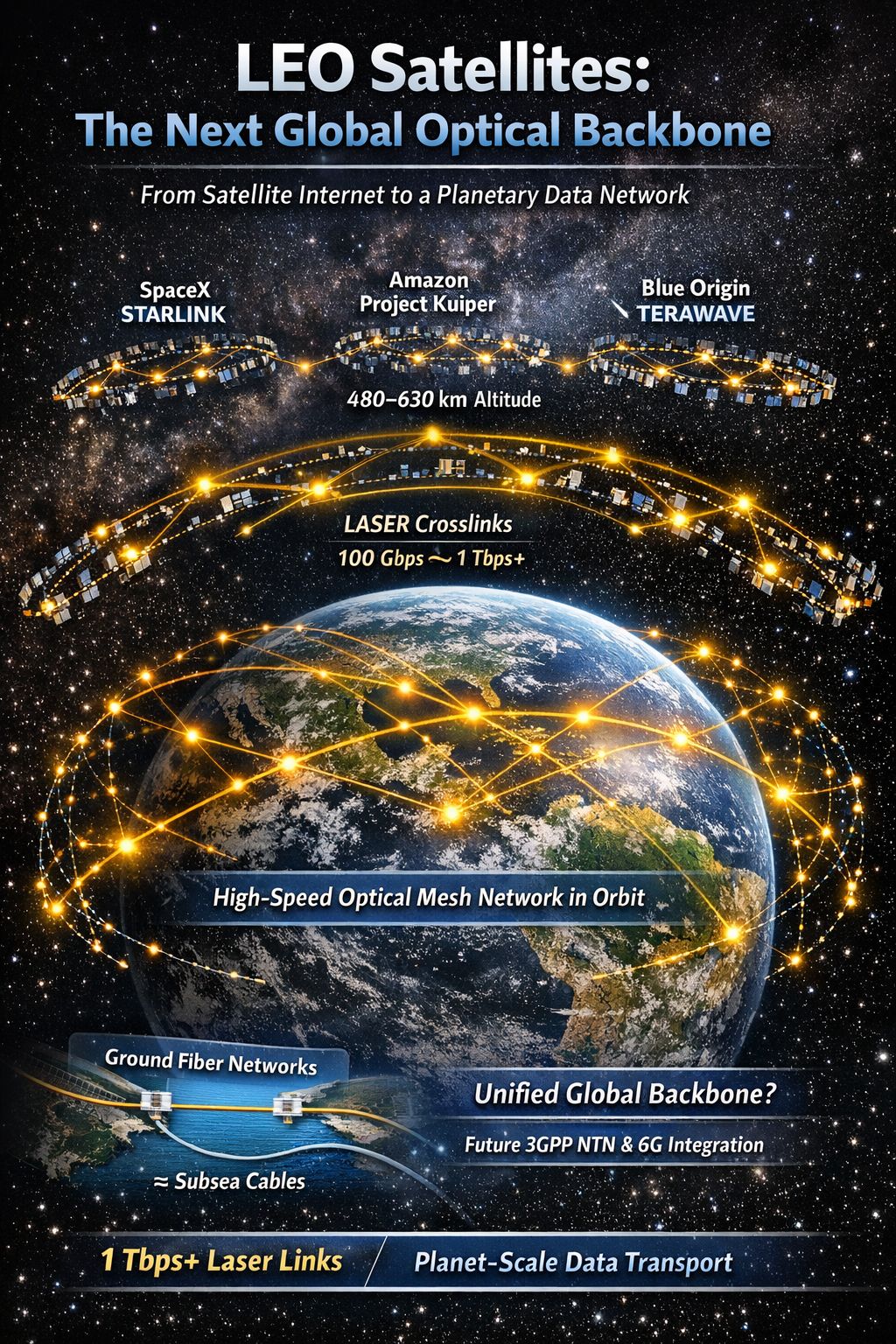
Low Earth Orbit (LEO) satellite systems are transitioning from simple broadband delivery platforms into a critical component of a global communications backbone. What is taking shape is not merely satellite-based internet access, but a spaceborne optical mesh that increasingly mirrors the structure and functionality of terrestrial fiber and subsea cable networks.
Major constellations, including SpaceX Starlink, Amazon’s Project Kuiper, and Blue Origin’s TeraWave, are deploying thousands of satellites at altitudes of approximately 480 to 630 km, with long-term plans extending to tens of thousands of spacecraft. However, the most significant transformation is not just the scale of deployment, but the adoption of Optical Inter-Satellite Links (OISL). These laser-based crosslinks enable direct data routing in orbit, reducing dependence on ground stations while simultaneously lowering latency and improving overall network efficiency.
Starlink has already implemented laser-enabled satellites that form a global optical mesh. Similarly, Amazon has demonstrated optical crosslinks exceeding 100 Gbps and intends to equip its entire Kuiper constellation with multi-directional laser terminals. Emerging players such as TeraWave are designing LEO and Medium Earth Orbit (MEO) systems specifically as high-capacity, terabit-scale backbones for cloud services, enterprise connectivity, and intercontinental data transfer.
OISL systems are expected to operate primarily in the near-infrared spectrum, with 1550 nm widely considered the optimal wavelength due to its technological maturity, favorable eye safety characteristics, and compatibility with coherent optical communication techniques. Future advancements, including wavelength division multiplexing (WDM), higher-order modulation formats, and coherent transmission, are anticipated to increase inter-satellite link capacities from the current range of 100–200 Gbps to 1 Tbps and beyond per link.
This progression leads to an important question: can LEO constellations eventually integrate into a unified global backbone comparable to today’s subsea fiber infrastructure? While current system designs remain largely proprietary, developments in 3GPP Non-Terrestrial Networks (NTN) and emerging 6G frameworks suggest increasing convergence between terrestrial and space-based communication systems. If standardization of OISL technologies is achieved at both the physical and network layers, inter-constellation routing could become a practical reality.
In such a scenario, Earth’s orbit would effectively function as a planetary-scale optical transport network, seamlessly interconnected with terrestrial fiber systems and data centers. LEO would no longer be defined solely by its role in extending coverage, but by its ability to fundamentally reshape the movement of global data.