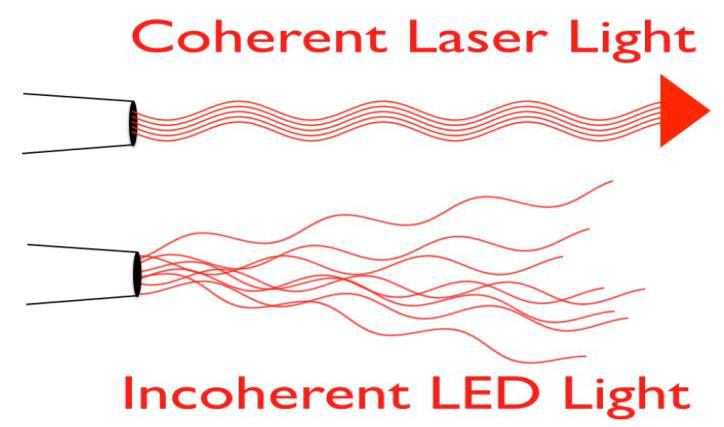
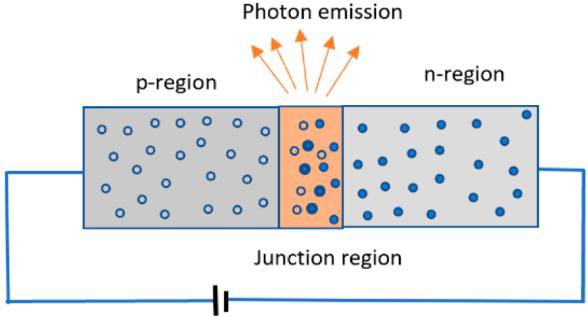
Light-emitting diodes also known as LEDs are commonly used as sources of light in many everyday applications. They produce electromagnetic radiation, but unlike lasers, the light from LEDs is incoherent . This means the emitted waves are not in the same phase and usually contain a range of wavelengths. The reason behind this behavior lies in how LEDs work. Light is generated through spontaneous emission inside a pn junction, where electron hole combination occurs randomly. Because of this random combination , the emitted photons do not maintain a fixed phase relationship, resulting in incoherent light. Also, LED emission is generally non-directional and follows a Lambertian pattern, spreading light over a wide angle rather than in a narrow beam.
Application and EMFT concept:
LEDs are also used as sources of optical electromagnetic radiation in short-range optical communication systems, such as fiber optic links for data transmission in local networks. In these systems, LEDs convert electrical signals into optical signals and these signals propagate through an optical fiber in the form of electromagnetic waves.
From the perspective of EMFT, the emitted light can be described as a transverse electromagnetic wave characterized by its frequency and wavelength. The relationship between these quantities is given by:
c = fλ
where c is the speed of light, f is the frequency, and λ is the wavelength. Since LEDs emit light over a range of wavelengths rather than a single frequency, the resulting signal is spectrally broad and incoherent.
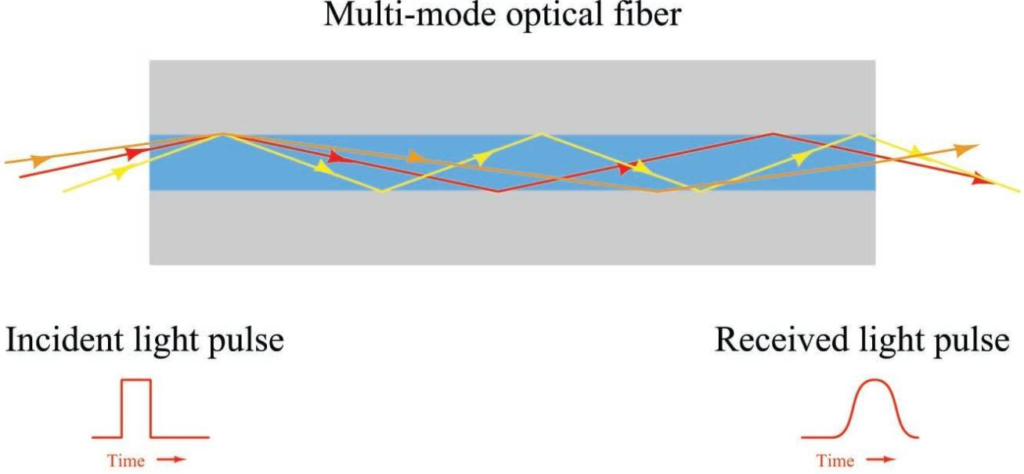
This incoherent nature of LED radiation affects how the signal propagates inside the optical fiber. Different wavelengths travel at slightly different speeds, leading to a phenomenon known as dispersion. As a result, the transmitted signal may spread over time, limiting the bandwidth and transmission distance of LED-based communication systems.
Despite this limitation, LEDs are still preferred in short-distance communication because they are cost-effective, reliable, and easier to operate compared to laser sources. Their non-directional emission also simplifies coupling into multimode fibers, making them suitable for applications where extremely high precision is not required.
Thus, LEDs serve as practical sources of optical EM radiation in communication systems, while also demonstrating key electromagnetic concepts such as wave propagation, spectral distribution, and dispersion.
Light-emitting diodes (LEDs) and lasers are both sources of optical electromagnetic radiation, but their characteristics are quite different. The main difference is in the nature of the emitted light, especially coherence, wavelength, and direction.
LEDs produce light through spontaneous emission, where photons are generated randomly. Because of this, the emitted waves are not in phase, so the light is incoherent. In contrast, lasers work on stimulated emission, which produces coherent light with waves that are phase-aligned.
Another difference is in wavelength. LEDs emit light over a range of wavelengths, so their output is not perfectly monochromatic. Lasers, however, produce light with a very narrow wavelength range, making them almost monochromatic.
In terms of direction, LED light spreads in many directions following a Lambertian pattern, while laser light is highly directional and forms a narrow beam. From an EMFT point of view, LEDs generate waves with random phase and varying frequency, whereas lasers produce synchronized waves with consistent phase and frequency.
Overall, LEDs are incoherent and broad-spectrum sources, while lasers are coherent and highly directional, which makes them suitable for different applications.