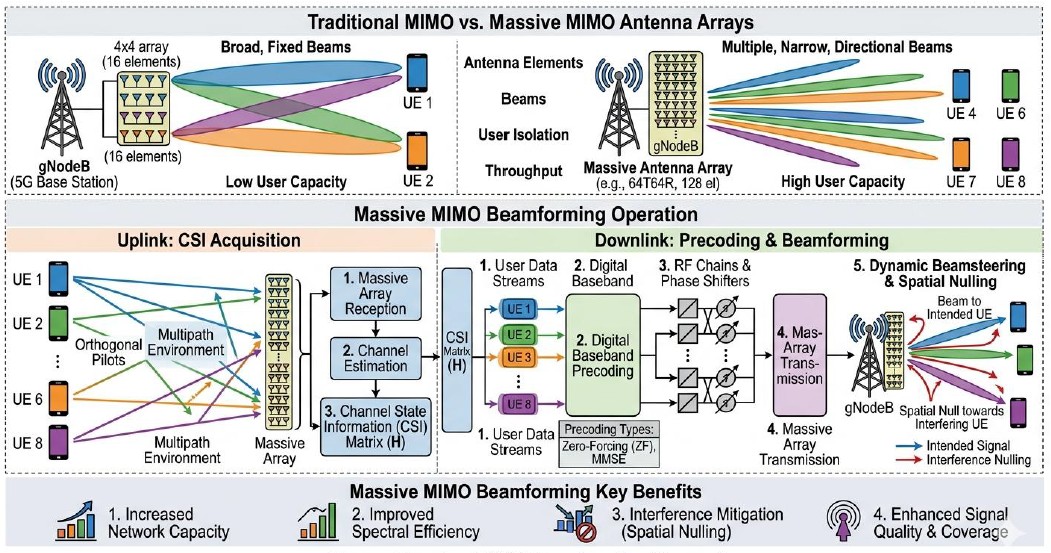
A massive MIMO (Multiple-Input Multiple-Output) system is an advanced wireless communication technique where a base station uses a very large number of antennas (tens to hundreds) to serve many users simultaneously in the same time-frequency resource.
1. Basic Idea
In a conventional system, one antenna serves one user (or a few users). In massive MIMO, the base station (BS) has M≫1 antennas and serves K users (K≪M) at the same time.
The key concept is:
- Spatial multiplexing: Different users are separated in space using beamforming.
- The BS can focus energy toward each user and suppress interference.
2. System Model (Simple Math)
Let:
- M: number of BS antennas
- K: number of users
- x∈CK×1: transmitted symbols
- y∈CK×1: received signals
- H∈CK×M: channel matrix
The received signal is:y=HWx+n
where:
- W∈CM×K: precoding (beamforming) matrix
- n: noise
3. Channel Representation
Each user has a channel vector:hk=[hk1,hk2,…,hkM]
So the channel matrix is:H=h1h2⋮hK
Each antenna experiences a slightly different channel → this is what enables spatial separation.
4. Beamforming Principle
The base station uses precoding to direct signals.
Example: Maximum Ratio Transmission (MRT)
For user k:wk=∥hk∥hkH
This means:
- The transmitted signal is aligned with the channel
- Signals add constructively at the intended user
5. Why Massive MIMO Works
(a) Channel Hardening
When M is very large:M1hkhkH≈constant
Effect:
- Small-scale fading averages out
- Channel behaves almost deterministic
(b) Favorable Propagation
For different users i=j:M1hihjH≈0
Meaning:
- Channels become nearly orthogonal
- Inter-user interference becomes very small
6. Uplink (Reverse Link)
In uplink, all users transmit simultaneously:y=HHx+n
The BS separates users using combining techniques:
- Maximum Ratio Combining (MRC)
- Zero-Forcing (ZF)
Example (MRC):x^k=hkHy
7. Key Benefits
1. Huge Capacity Gain
Supports many users simultaneously:Sum Rate∝Klog2(1+SINR)
2. Energy Efficiency
Transmit power per antenna can be reduced:P∝M1
3. Interference Reduction
Due to near-orthogonality of channels.
8. Simple Intuition
Think of massive MIMO as:
- Instead of broadcasting everywhere (like a bulb),
- It acts like a laser beam, focusing energy precisely toward each user.
With many antennas:
- The system “learns” the spatial signature of each user
- It transmits signals that add up only at the desired user location
9. Practical Challenges
- Channel estimation (especially pilot contamination)
- Hardware complexity
- Synchronization
- Signal processing overhead
10. Summary
Massive MIMO works because:
- Many antennas → spatial resolution
- Beamforming → targeted transmission
- Large MMM → channels become orthogonal
- Interference reduces naturally
Mathematically, the key idea is:y=HWx
and with large M:HHH≈diagonal
which makes multi-user separation easy.