
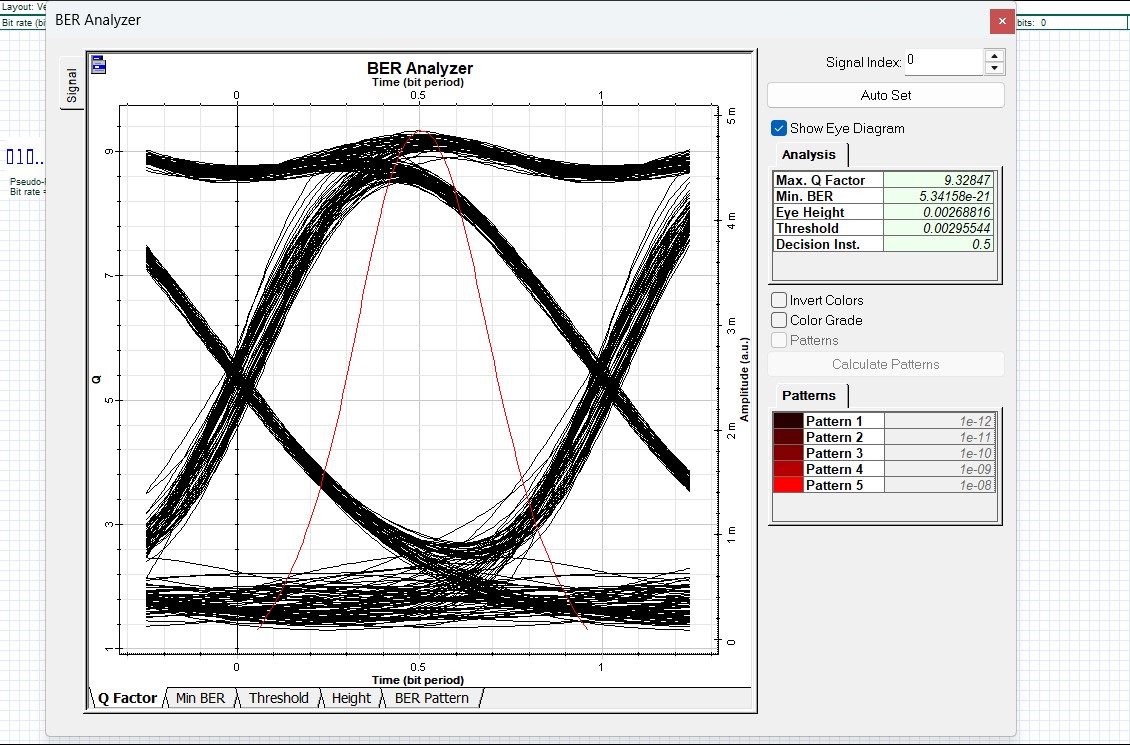
Direct modulation is a technique in optical communication where the drive current of a laser diode is directly varied to encode information onto the optical carrier. In this approach, the electrical data signal modulates the intensity (and indirectly, other characteristics) of the emitted light without requiring an external modulator.
How It Works
A semiconductor laser diode (such as a Distributed Feedback, DFB, laser) is biased above threshold.
The input current is varied in proportion to the digital or analog data signal.
The resulting optical output power follows the current modulation, producing intensity-modulated light that carries the information.
Key Characteristics
- Simplicity: Direct modulation eliminates the need for external devices (e.g., Mach–Zehnder modulators), reducing cost and system complexity.
- Speed limitations: The modulation bandwidth is constrained by the laser’s relaxation oscillation frequency and chirp effects.
- Chirp generation: Direct modulation inherently produces frequency chirp (wavelength fluctuations due to refractive index changes in the laser cavity). This can cause signal distortion over long fiber links due to chromatic dispersion.
Advantages
- Cost-effective — no external modulators required.
- Compact design — suitable for short-reach optical interconnects.
- Low power consumption — efficient for short-haul data transmission.
Limitations
- Limited transmission distance — due to dispersion and chirp-induced penalties.
- Lower spectral purity compared to externally modulated lasers.
- Restricted data rates — typically suitable for moderate-speed links.
Applications in Optical Communication
Direct modulation is widely used in:
Cost-sensitive systems where simplicity and low power outweigh the need for ultra-long-haul performance.
Short-reach fiber links (e.g., data centers, metro networks).
Passive Optical Networks (PONs) for broadband access.