
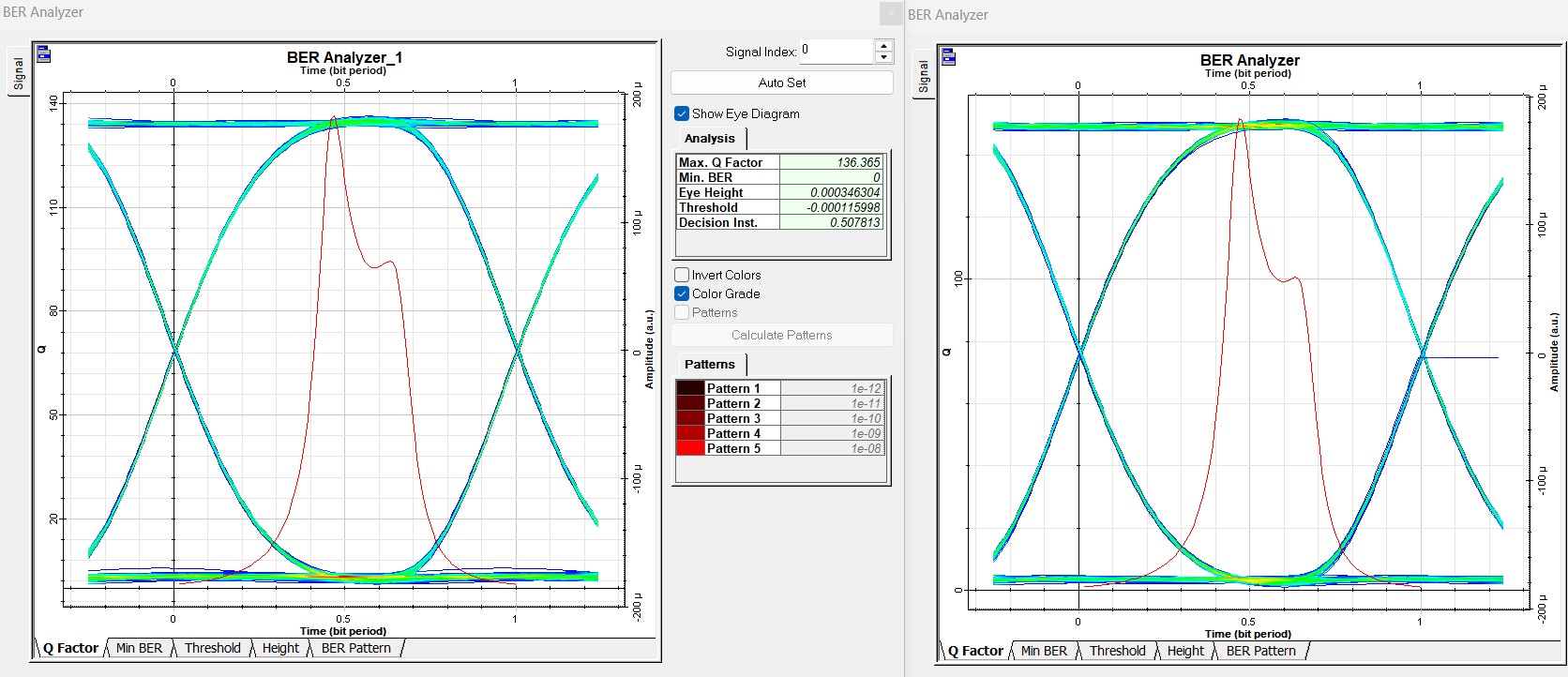
Differential Quadrature Phase-Shift Keying (DQPSK) is an advanced optical modulation format in which information is encoded in the phase difference between consecutive optical symbols, with four possible phase shifts. Unlike Differential Phase-Shift Keying (DPSK), which transmits 1 bit per symbol, DQPSK transmits 2 bits per symbol, effectively doubling the data capacity without requiring extra bandwidth.
How It Works
The optical carrier phase is shifted among four discrete values:
0, π/2, π, 3π/2
Each phase shift corresponds to a unique 2-bit symbol (00, 01, 10, 11).
The transmitter typically uses a dual-drive Mach–Zehnder Modulator (MZM) to generate these controlled phase shifts.
The receiver employs a delay-line interferometer (DLI) with two arms shifted by 90° (quadrature). This setup allows detection of both in-phase (I) and quadrature (Q) components, enabling symbol recovery.
Advantages
- Higher spectral efficiency — doubles the bit rate compared to binary DPSK for the same symbol rate.
- Improved OSNR tolerance — more resilient against optical noise than simple On–Off Keying (OOK).
- Reduced nonlinear penalties — constant-intensity signaling reduces sensitivity to fiber nonlinear effects.
Challenges
- Increased receiver complexity — requires two interferometers and balanced detection.
- Tighter phase stability requirements — precise synchronization is needed between symbols.
Applications in Optical Communication
Optical DQPSK is widely deployed in high-capacity DWDM systems and long-haul transmission networks, offering a good trade-off between:
- Spectral efficiency
- Noise tolerance
- Implementation complexity
It has been one of the most popular modulation formats in 40 Gb/s and 100 Gb/s optical transport networks (OTN), before coherent detection methods like QPSK and QAM became dominant.