
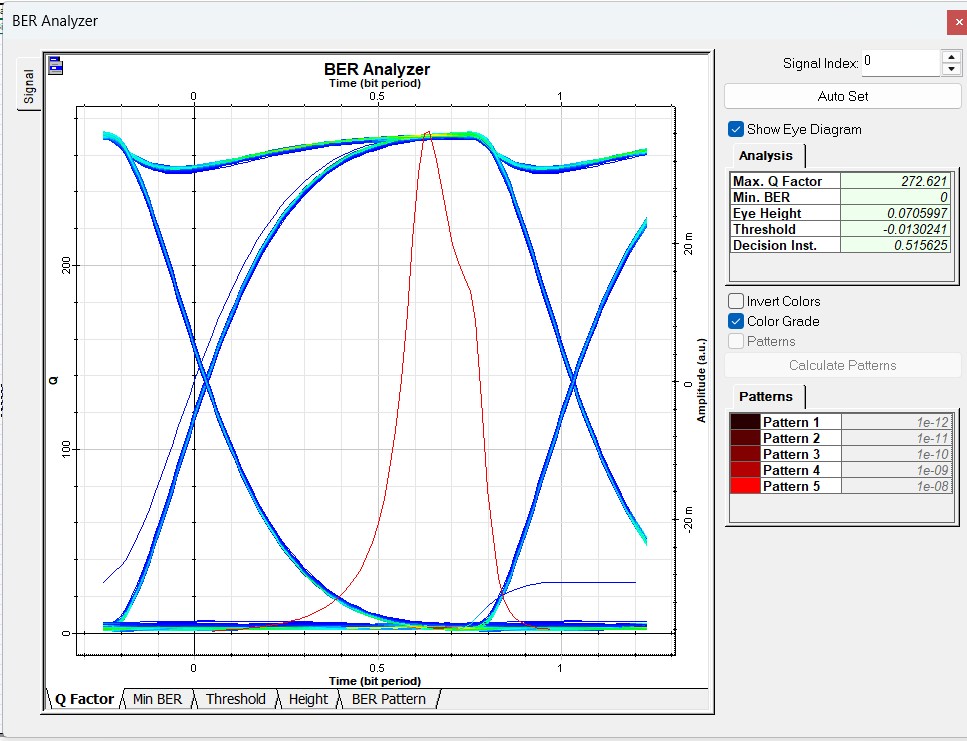
Differential Phase-Shift Keying (DPSK) is a phase modulation technique used in optical communication systems where information is carried in the phase difference between consecutive optical pulses rather than in the absolute phase of the carrier.
In optical DPSK, a binary “0” or “1” is represented by whether the phase of the current pulse remains the same or is shifted by π\piπ radians relative to the previous pulse.
How It Works
The transmitter uses a Mach–Zehnder Modulator (MZM) to impose phase shifts on an optical carrier.
The receiver employs a delay-line interferometer (DLI) that compares the phase of each pulse with the previous one.
If the phase difference = 0 → bit “0”
If the phase difference = π → bit “1”
Key Features
- Improved receiver sensitivity — typically offers a 3 dB advantage compared to On–Off Keying (OOK).
- Constant optical power — makes DPSK more robust against fiber nonlinearities.
- Narrower optical spectrum — leading to higher spectral efficiency.
Applications in Optical Communication
Optical DPSK is widely used in long-haul and high-capacity fiber optic systems because it provides:
A balance between complexity and performance, compared to more advanced coherent modulation formats..
Better tolerance to noise and dispersion compared to OOK.
Higher spectral efficiency, making it suitable for dense Wavelength Division Multiplexing (DWDM) systems.