
The transmission of electromagnetic waves is an important factor for communication. In this paper, two types of propagation technologies will be compared: free space propagation and fiber optics. The main features of each technology are discussed alongside the principles of operation and practical use, as well as relevant theoretical principles from the theory of electromagnetics (EMFT). The free space propagation technique allows wireless communication but suffers from signal loss and interference. On the other hand, fiber optic technology supports high-speed communication due to the guided wave concept and total internal reflection phenomenon..
The process of wave propagation for electromagnetic waves forms the base of all communication systems today. EM waves can travel in different media either through an unguided or guided medium. However, both methods use Maxwell’s Equations to accomplish transmission but differ considerably depending on whether there exists a physical medium or not.
Unguided propagation is used widely for wireless communication, whereas guided wave propagation forms the basis for fast internet connections. The distinctions between these two propagation techniques must be understood well for proper communication system design.
EM Wave Propagation in Free Space:
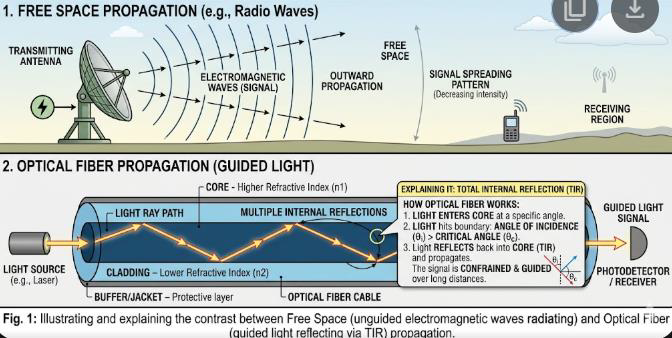
The term ‘free space propagation’ describes the behavior of electromagnetic waves that propagate in free space, either in air or vacuum without the use of any guide. Here, electromagnetic waves radiate in all directions from their source.
EM Wave Propagation in Optical Fiber
Optical fiber uses a dielectric medium to guide electromagnetic waves in the form of light. The fiber consists of a core surrounded by cladding, and wave propagation occurs due to total internal reflection.
Maxwell’s Equation:
The laws of Maxwell’s Equations underlie the physics of electromagnetic wave propagation. These laws govern the generation of electric and magnetic fields and their propagation in space. Under free-space conditions, Maxwell’s Equations dictate that the electric and magnetic fields vary with time, generate each other, and propagate in space as electromagnetic waves. Under optical fiber conditions, Maxwell’s Equations still
govern the physics of electromagnetic waves but with dielectric boundaries affecting field generation and propagation.
Boundary Conditions:
The conditions along the boundary are vital in understanding the behavior of the electromagnetic fields where two dissimilar media meet.
For optical fibers, the interface between the core and the cladding ensures that the fields obey the continuity condition; hence, they confine the wave, thus facilitating the transmission process.
However, when considering free space, there is nothing to limit the wave from spreading. Consequently, this results in low power density as a function of distance.
Therefore, boundary conditions are what make it possible for optical fibers to transmit waves in contrast to free space.
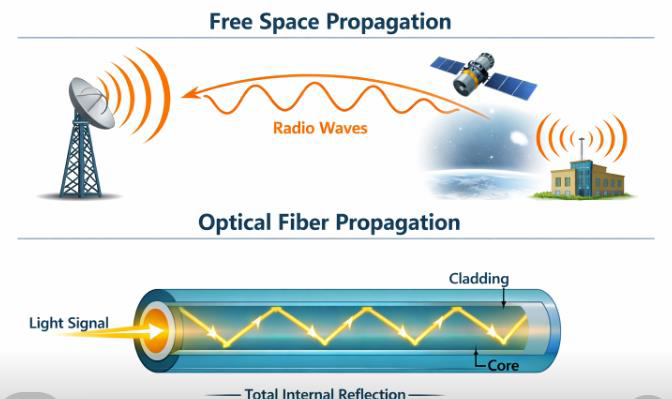
Free space propagation: The signal, which is the radio wave, propagates through the air from the transmitter’s antenna to somewhere else.
Optical fiber propagation: The signal that uses light propagates through the cable using total internal reflection.