
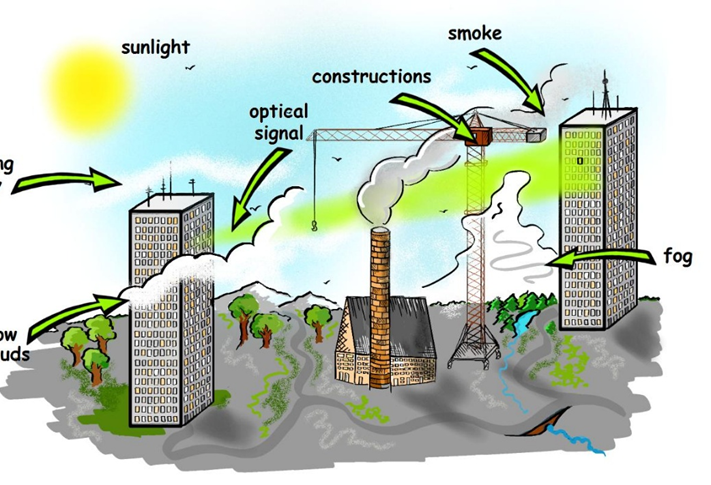
Free space Optical (FSO) communications refer to the emerging method of wireless communication that uses electromagnetic waves in optical (infrared/visible light) spectrum to transmit data. In a typical FSO system, a transmitter sends a beam of electromagnetic radiation through atmosphere which is converted into electrical signal by a photodetector receiver. This method of communication is greatly impacted by surrounding conditions such as fog, rain and turbulence. Currently the system is widely deployed in satellite communication, building to building links and 5G backhaul where Fiber installation is costly or impractical.
In urban areas, FSO systems are used to connect buildings over distances ranging from a few hundred meters to a several kilometres. A laser transmitter from rooftop of one of the buildings transmit a narrow beam of data towards the receiver of the other building. However, due to atmospheric conditions such as fog, signal strength can drop significantly due to:
- Scattering & Absorption of EM Waves
This makes atmospheric attenuation one of the biggest challenges in FSO system design.
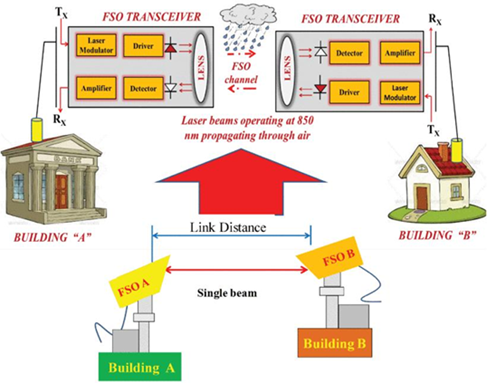
In FSO systems the aspect of Electromagnetic wave propagation is governed by Maxwell’s equations, which describe how electric and magnetic fields interact and propagate through space.
Wave Equation:
This equation helps show that EM waves propagate through space as oscillating electric and magnetic fields. In FSO systems atmospheric attenuation can occur due to multiple reasons. Absorptionoccurs when atmospheric gases such as carbon dioxide and water vapor absorb optical energy and convert it into heat. This weakens the signal strength as it propagates through the atmosphere. Scatteringis the dominant attenuation mechanism in these systems and occurs when particles like rain, fog and dust deflect these electromagnetic waves. Fog can cause extremely high attenuation as it sometimes exceeds 200 dB/km which can completely disrupt the signal. Another reason for attenuation of the signal is Turbulencewhich can occur due to variations in pressure and temperature causing fluctuations in the refractive index of the air leading to scintillation (signal fading), Beam wandering and Phase distortion. In practical systems, laser beams spread over distance due to diffraction which significantly reduces the power density at the receiving node. As distance increases, beam spreading causes additional signal loss which is known as geometric attenuation.
The attenuation of EM Waves in FSO Systems is commonly modelled using:
Beer-Lambert Law:
: received power
: transmitted power
: antenna gains
: link distance
The equation helps model the exponential decay of power. It provides a simplified model to estimate atmospheric attenuation in FSO systems. Showing that optical signal Power decays exponentially with distance due to absorption and scattering of electromagnetic waves.