
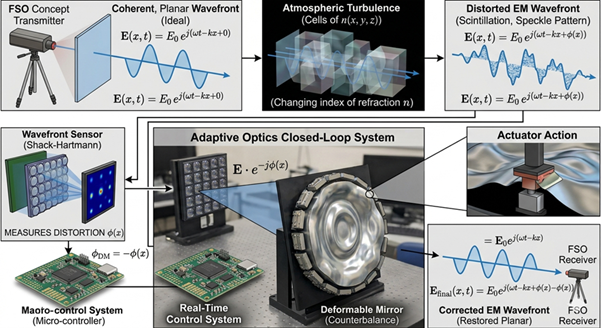
Free space optical (FSO) communication is an advanced wireless technology that uses electromagnetic (EM) waves in the optical spectrum to transmit data through the atmosphere. It provides high data rate, unlicensed spectrum, and cheap deployment. However, atmospheric disturbances like turbulence, temperature and pressure fluctuations distort the propagation of the EM wavefront, thus degrading system performance. Adaptive optics (AO) is a great technique used for correcting the distortions in real time.
The use of an adaptive optical system is an advanced technique used to mitigate impact atmospheric turbulence on FSO links. Its three contemporaneous components incorporate a wave front sensor to assess distortion, a wavefront corrector to counterbalance the distortion, and a predominant system to consider the modified correction and obligatory shape that is to be regulated via the corrector. The main aim of any adaptive optical technique is to present a phase correction in the incoming wave front that changes an aberrated wave front into a plane wave.
Application Scenario In FSO communication systems, a laser beam used for transmitting information travels through the atmosphere from transmitter to receiver. Random changes of refractive index in air due to atmospheric turbulence cause phase distortions in EM wavefronts. This causes the beam to spread and scintillate, thus reducing received power. The communication for FSO is getting advanced with the use of different and new technologies. Increasingly, systems are making use of newer technologies to enhance their capabilities and adaptability. The objective of FSO transceiver design is to be reliable. Quantum cryptography helps to transmit data over long distances securely.