
1. EHF Band Potential (30-300GHz)
In recent years, many conventional radio frequency bands have been congested. On the contrary, EHF band provides us with a huge and quite unoccupied frequency range that may be used for broadband and 5G cellular connections. Although such a range allows increasing data rate significantly, at the same time it poses serious problems, especially atmospheric interference.
2. The Problem – Interference from Atmosphere
Unlike radio waves, mm waves demonstrate great sensitivity to the characteristics of propagation channel. Passing through air, waves suffer from
Amplitude distortion: the signal gets weaker due to absorption by atmospheric components or scattering.
Phase dispersion and group delay. Up until now, there has been an opinion that all the models of wireless channels considered only attenuation. The paper states that it is necessary to consider all the aspects of signal behavior in order to make more precise estimations.
3. The New Approach to Wireless Channels Modelling
In this research, the authors introduce a space-frequency model of channels in the EHF band. In particular, it takes into consideration
Atmospheric characteristics like cloudiness and precipitation rate.
Medium dielectric properties like permittivity and refractivity.
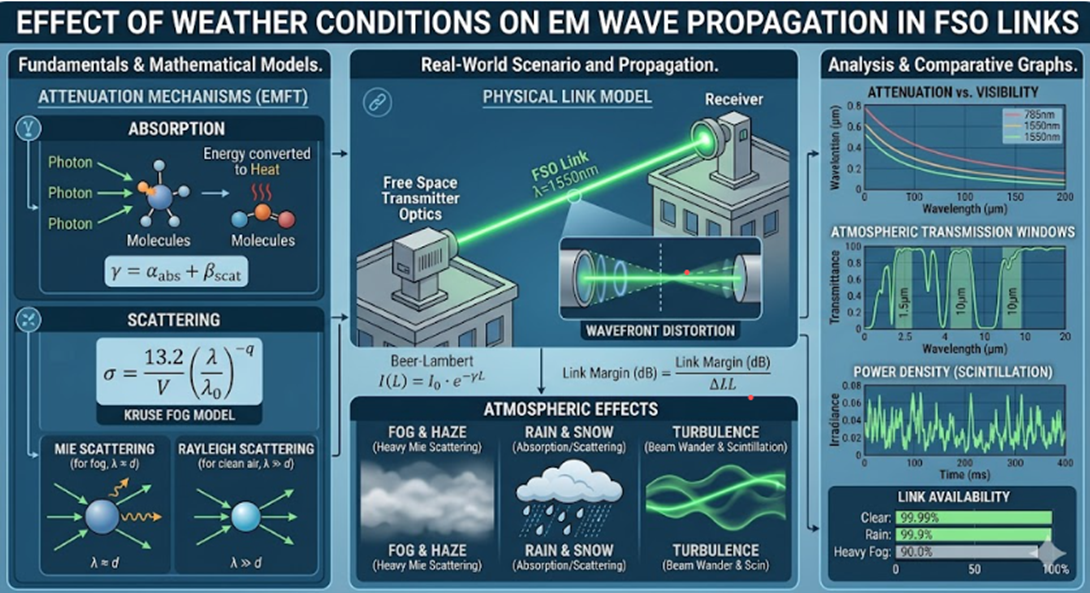
In FSO, the transmission of data is governed by the propagation of high-frequency electromagnetic waves. When these waves encounter atmospheric particles, two primary EMFT phenomena occur: Absorption and Scattering.
- Absorption: Occurs when photons interact with atmospheric molecules (like water vapor or CO2), converting EM energy into heat.
- Scattering: Occurs when the wave hits particles (fog, rain, dust). If the particle size is comparable to the wavelength, it follows Mie Scattering; if the particles are much smaller (like gas molecules), it follows Rayleigh Scattering.
Scenario of Application in the Real World: Effect of Weather
For an average city-based FSO configuration between two buildings, the link budget calculation assumes “clear air.” However, the effect of weather is very substantial and impacts greatly on the refraction index (n) of the air and number of the particles involved, thus affecting the transmission adversely.
1. Fog and Haze (A Major Hindrance)
Water drops of fog have similar dimensions (approx. 1–20) that are close to the wavelengths of FSO (for example, 1550 nm). The result of such proximity is heavy Mie scattering, causing losses more than 100 dB/km, making the signal undetectable by the receiving end.
2. Rain and Snow
Due to their larger sizes compared to the wavelengths, raindrops attenuate the signal, yet not as extensively as in the case of fog, since the “scattering cross-section” differs greatly. As for snow, due to the variety of shapes, it is able to create fluctuation and scattering.
3. Atmospheric Turbulence Atmospheric temperature fluctuations create “pockets” of air with different densities called turbulent eddies. They act as prisms for the bending of EM waves, moving the signal out of the way from the receiving apparatus.