
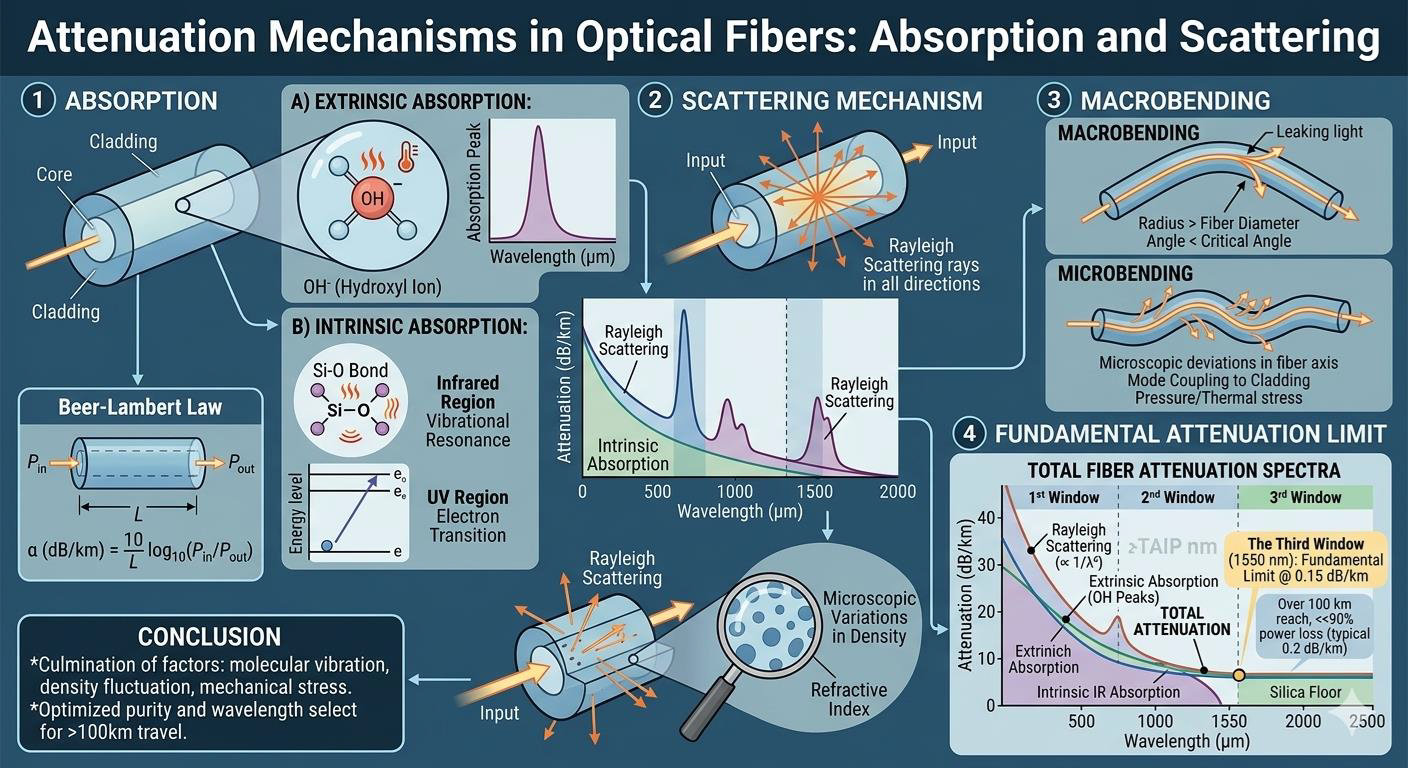
In optical communication, the efficiency of signal transmission is determined by attenuation, the gradual loss in the signal strength as it propagates through a medium [1]. Attenuation determines the maximum distance a signal can travel until it requires amplification. Absorption and Scattering are two primary reasons for signal degradation as the signal passes through a medium [2].
Absorption:
Absorption occurs when the energy of the moving photon inside an optical fiber is transferred to the atoms or molecules of the glass, resulting in heat energy produced [3]. Absorption can further be divided into extrinsic and intrinsic types. A. Extrinsic Absorption:
These absorptions are predominantly caused by the impurities inside the glass. The most significant out of these is the water impurity ($OH^-$ $\rightarrow$ Hydroxyl Ion Impurity). Even minute traces of water can lead to massive absorption peaks due to the harmonic vibrations of the OH Bond [2], [4].
B. Intrinsic Absorption:
This arises due to the molecular structure of the silica glass itself. Absorption is caused by the electron transition between energy levels within the UV-Region. Whereas in the infrared region, the loss is caused by vibrational resonance of the Si-O bond [1].
- Scattering Mechanism: Rayleigh Scattering
Scattering is a phenomenon which steers the electromagnetic wave away from the desired path, preventing it from reaching the desired receiver [5]. The dominant form is the Rayleigh Scattering in optical fibers.
Microscopic variations in density and refractive index of silica glass mainly cause the Rayleigh scattering. These variations arise during the manufacturing of the silica glass and are frozen into the glass during the cooling process [1], [3].
3.Macrobending and Microbending
While absorption and scattering are material-dependent, structural factors also contribute to attenuation.
Macrobending occurs when the fiber is bent into a curve with a radius larger than its diameter. This causes the electromagnetic wave’s angle of incidence to drop below the critical angle, causing light to leak out [4].
Microbending refers to the microscopic deviations in the fiber-axis. These deviations are often caused due to uneven pressures at certain points during the cabling process or thermal expansion/contraction of the fiber coating. - Fundamental Attenuation Limit
- Even if an engineer could produce a fiber with zero chemical impurity inside perfect vacuum, and perfect structural geometry, the signal would still face attenuation. This limit is defined by the intersection of Rayleigh Scattering and Infrared Absorption [1]. Rayleigh Scattering decreases as wavelength increases while infrared absorption increases beyond $1600\text{ nm}$ due to Si-O molecular vibrations. This crossover creates a “third-window” at $1550\text{ nm}$, where attenuation hits its absolute theoretical floor.