
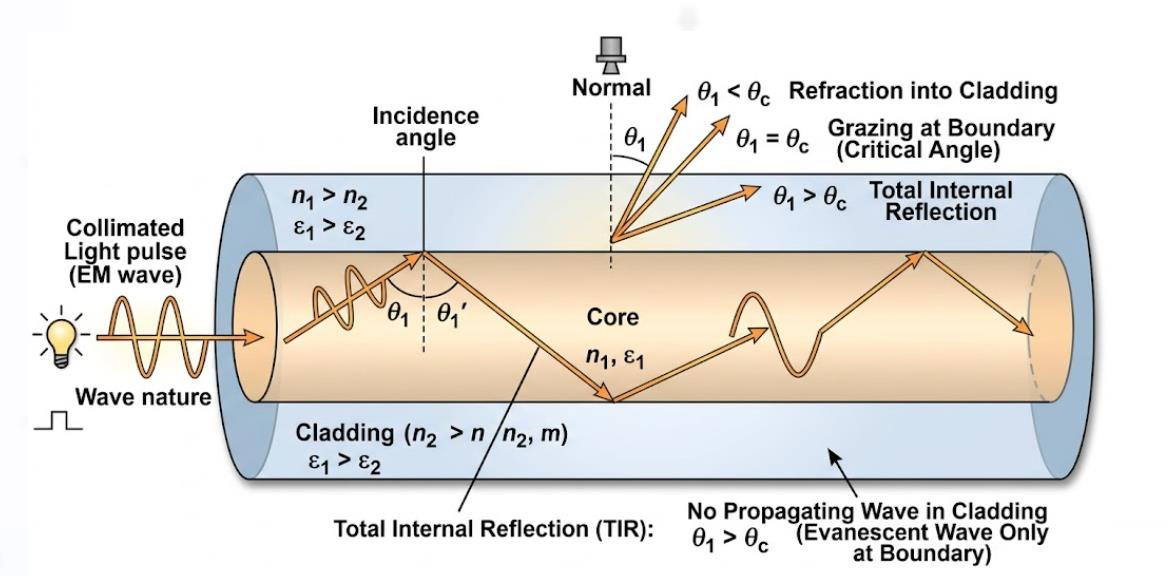
Optical fibers are the backbone of modern communications. In this article , we will see that how EMFT concepts like boundary conditions explains Total Internal Reflection in optical fibers. We will also analyze that how Electromagnetic waves interact at the interface of two dielectric media with different permittivity i.e. we will check how light behaves in fiber core. Mathematical analysis, using Snell’s law and electromagnetic equations shows which is needed to keep signal integrity in modern networking as we know that this is critical requirement of every system to maintain its integrity with physics laws.
Electromagnetic waves do lots of things when they meet objects like reflection, refraction, diffraction. In the world of telecommunications information is sent as fast pulses of light that travel through super thin wires made of glass or plastic which are called optical fibers. A regular optical fiber has two layers; First is the core, which is the middle part where the light goes and second is the cladding, which is the outer layer that is designed to have a slightly lower refractive index. The core of a fiber is important because it is the central pathway for the light and the cladding is important because it helps keep the light inside the core of the optical fiber due to its low refractive index.
The main challenge in the world of engineering is that we want to prevent the electromagnetic energy from getting out into the surrounding area when it travels a long way. When light goes into cladding from core , it becomes weak. To overcome this challenge , engineers use the concept of Total Internal Reflection. This is the opposite of what we did with stealth technology as explained in my previous assignment, which is meant to scatter and absorb energy so it does not bounce back, to where it came from and hence we can prevent them to reach the radar to prevent detection. Optical fibers are designed to do the opposite. They keep bouncing the energy into the center so no energy is lost when it hits the edge of the center and the outer layer i.e. they kept reflecting from cladding to core and hence preventing the energy of waves between core and cladding interface using concepts of boundary conditions.