Imagine being in a crowded, high-energy networking event where you are trying to listen to an important piece of advice. The environment is filled with loud music, overlapping conversations, and background noise, making it difficult to focus on the message. This situation closely resembles the challenge faced by an Optical Wireless Communication (OWC) receiver, which must continuously extract useful information from a noisy environment.
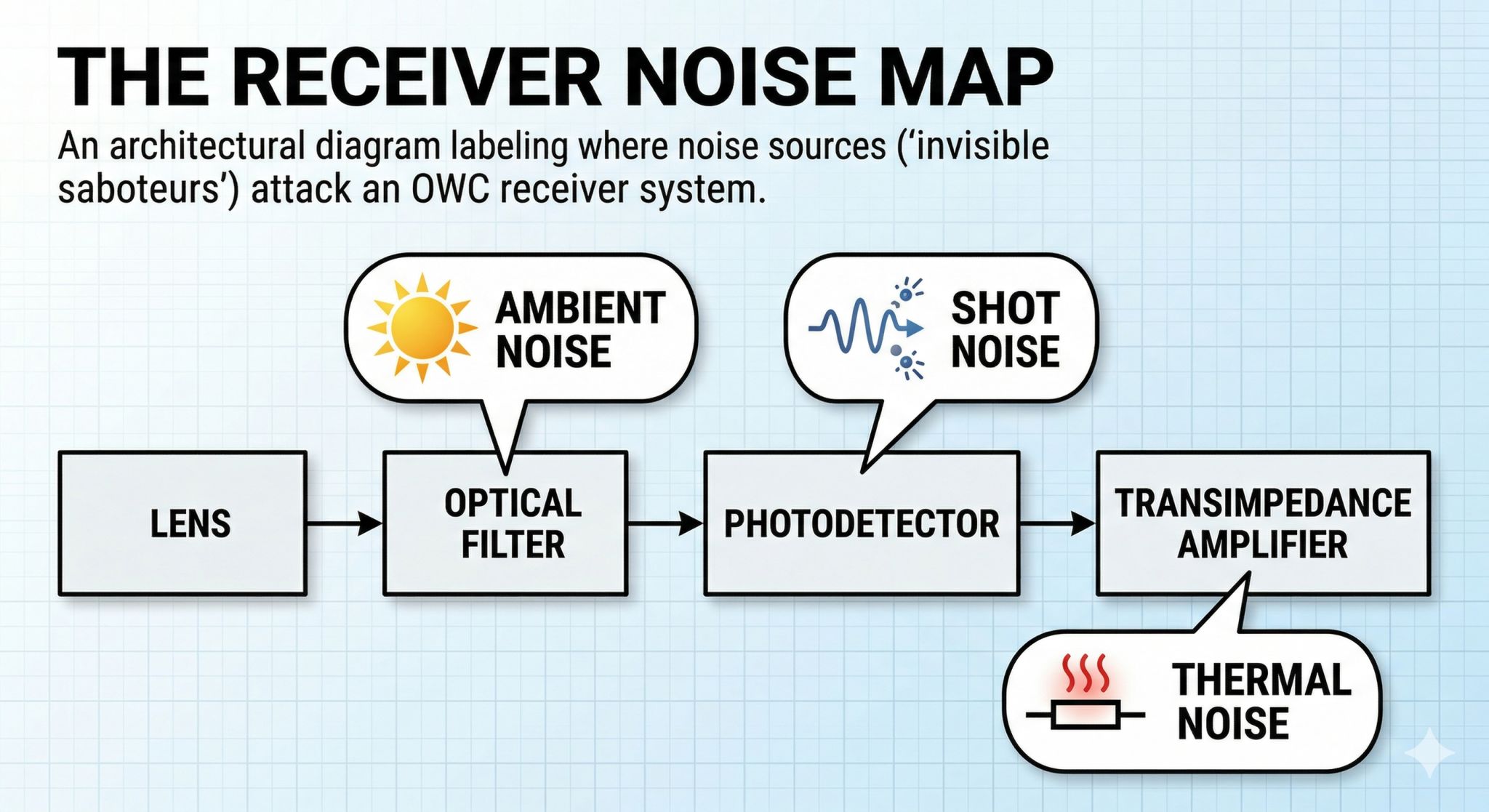
In systems such as LiFi and Free-Space Optics (FSO), noise is a fundamental limitation that degrades signal quality and system performance. It is not a single source but a combination of multiple physical phenomena that collectively obscure the transmitted signal.
Sources of Noise
Several types of noise affect OWC systems:
- Shot Noise
Due to the discrete nature of photons and electrons, random fluctuations occur in the detected signal. This effect becomes more pronounced at low signal levels where photon arrivals are sparse. - Thermal Noise
Thermal agitation of electrons in electronic components generates a continuous background noise, independent of the optical signal. - Ambient Light Interference
External light sources, such as sunlight or artificial illumination, introduce significant interference by adding unwanted optical power at the receiver, making signal detection more challenging. - Dark Current and Relative Intensity Noise (RIN)
Photodetectors generate a small current even in the absence of light, known as dark current. Additionally, fluctuations in the output power of optical sources contribute to RIN, causing variations in the noise floor.
Impact on System Performance
The presence of noise directly affects communication quality:
- Reduction in signal-to-noise ratio (SNR), making reliable detection difficult
- Increase in bit error rate (BER), leading to data corruption
- Limitation on achievable transmission range, regardless of transmit power
Mitigation Techniques
To maintain reliable communication, OWC systems employ several advanced techniques:
- Optical Filtering
Selective filtering allows only the desired wavelength band to reach the detector, reducing interference from ambient light. - Adaptive Threshold Detection
The receiver dynamically adjusts decision thresholds based on real-time signal and noise conditions, improving detection accuracy. - Forward Error Correction (FEC)
Techniques such as LDPC and Turbo codes enable reconstruction of corrupted data, enhancing link reliability. - Low-Noise Circuit Design
Careful electronic design minimizes internally generated noise, improving overall system sensitivity.
Future Direction
Traditionally, noise has been treated as a fixed limitation that must be mitigated. However, emerging approaches based on machine learning are transforming this perspective. Intelligent or “cognitive” receivers can learn the statistical characteristics of noise in a given environment and adaptively suppress it in real time.
The future of OWC systems will depend not only on increasing optical power or bandwidth, but also on developing smarter, quieter receivers capable of operating reliably in complex and dynamic environments.