In the world of computing, “random” usually isn’t actually random. If you ask a standard computer to pick a random number, it uses a complex math formula. It looks random to a human, but if you knew the starting point (the “seed”) and the formula, you could predict every single number that follows. This is called Pseudorandomness.
For things like Spotify shuffle, pseudorandom is fine. For high-stakes encryption, national security, or complex scientific simulations, “fine” isn’t good enough. We need True Randomness—numbers that are fundamentally unpredictable because the universe itself hasn’t decided what they are yet.
That is where Photonics-Based Quantum Random Number Generators (QRNG) come in. They don’t use math to find randomness; they use the “weirdness” of light.
The Problem with Classical “Random”
Imagine a professional coin flipper. If you had a super-high-speed camera and a computer that could measure the exact force of the thumb, the air resistance, and the floor’s bounciness, you could calculate exactly how the coin will land. In a classical world, everything is just a chain of cause and effect.
Quantum mechanics breaks that chain. At the subatomic level, some events are truly, fundamentally spontaneous.
The “Recipe” for a Photonics QRNG
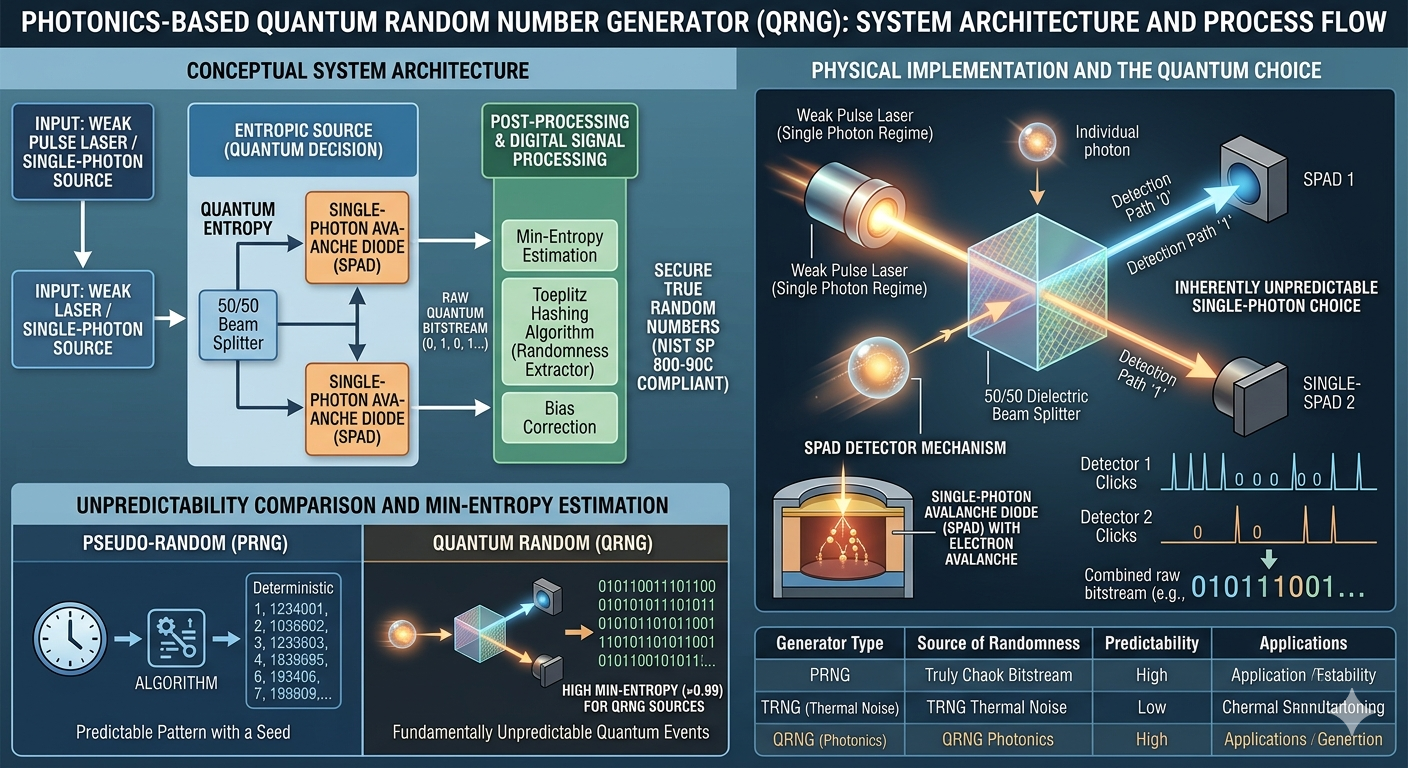
The most elegant way to build a QRNG is by using a Beam Splitter. Think of this as a “half-silvered” mirror—a piece of glass that is designed so that exactly 50% of the light that hits it passes through, and 50% reflects off.
The Components:
- A Weak Laser Source: We need a light source that fires individual photons (particles of light) one at a time.
- The Beam Splitter: This is the “fork in the road.”
- Two Detectors (SPADs): We place one detector behind the mirror (Path A) and one to the side (Path B).
- A Processor: A simple chip to record which detector “clicked.”
How It Works: Step-by-Step
- The Approach: Alice (or the machine) fires a single photon at the beam splitter.
- The Quantum Choice: When the photon hits the beam splitter, it doesn’t “decide” which way to go based on some hidden internal logic. According to the laws of quantum mechanics, the photon exists in a superposition—it is essentially taking both paths at once until it is measured.
- The Measurement: The photon eventually hits one of the two detectors. The moment it hits, the superposition “collapses.” It either goes to Path A or Path B.
- The Bit Generation: * If Detector A clicks, the computer records a 0.
- If Detector B clicks, the computer records a 1.
- The Result: Because the choice at the beam splitter is governed by quantum probability rather than physical force, there is no way—not even in theory—to predict whether the next bit will be a 0 or a 1.
Why “Photonics” is the Winner
You can make quantum random numbers in other ways (like measuring the decay of radioactive atoms), but photonics is the gold standard for a few reasons:
- Speed: Light is the fastest thing in the universe. Photonics-based QRNGs can generate billions of random bits per second (Gbps), which is fast enough for high-speed data centers.
- Size: We can now shrink these lasers and beam splitters down onto tiny silicon chips. In fact, some modern smartphones already have a tiny QRNG chip inside them to make your encryption keys more secure.
- Robustness: Photons don’t interact much with the environment (unlike electrons or ions), so the “randomness” doesn’t get corrupted by heat or outside electronic noise as easily.
Comparison: How Random is Random?
| Type of Generator | Source of Randomness | Predictability | Primary Use |
| Pseudorandom (PRNG) | Mathematical Algorithms | Predictable if you know the “seed.” | Video games, UI effects, basic apps. |
| Hardware Random (TRNG) | Atmospheric noise, thermal jitter | Very hard to predict, but “chaotic” rather than “quantum.” | Standard PC security. |
| Quantum Random (QRNG) | Quantum state collapse (Photons) | Fundamentally Unpredictable. | Quantum cryptography, lotteries, high-level research. |
The “Reality Check”: Post-Processing
In a perfect world, a beam splitter is exactly 50/50. In the real world, maybe it’s 50.001% to 49.999%. This is called a bias. If a spy knew your generator had a tiny bias toward “1,” they could technically improve their odds of guessing your key.
To fix this, photonics QRNGs use Extraction Algorithms. These are “cleansing” steps that take the raw stream of quantum bits and run them through a mathematical process (like a Toeplitz hash) to ensure that the final output is perfectly uniform. The result is a stream of numbers that are as close to “perfect” as the laws of physics allow.
Fun Fact: If you used a QRNG to play a game of roulette, even a god-like supercomputer from the future couldn’t predict where the ball would land. It’s not just a secret; it’s a secret that hasn’t been decided yet.