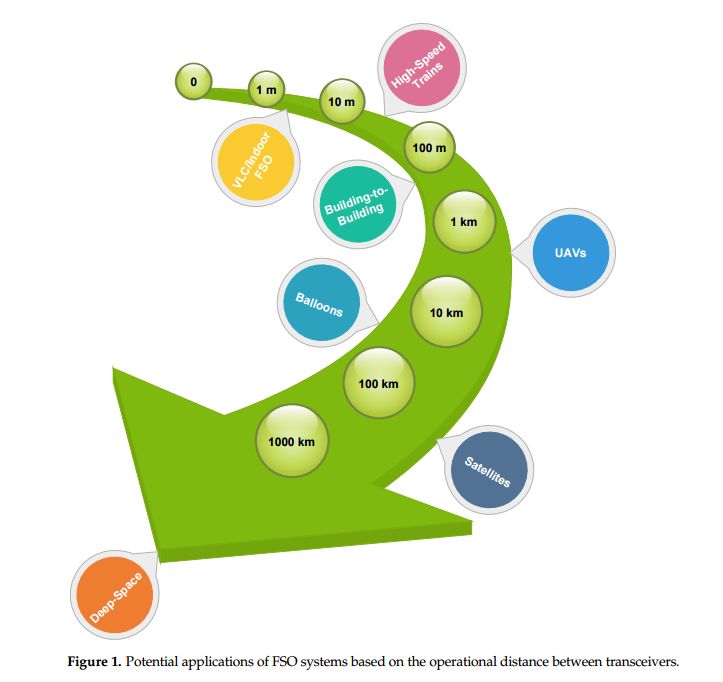
Free-Space Optical (FSO) communication, an important subset of Optical Wireless Communication (OWC), is emerging as a strong complement to radio frequency (RF) systems rather than a replacement. It enables high-speed data transmission using modulated light beams, particularly in scenarios where deploying fiber is impractical or where RF systems face spectrum congestion and interference limitations.
FSO systems offer several notable advantages. They can support extremely high bandwidth, potentially reaching terabit-per-second data rates using unlicensed optical spectrum. Their narrow beam characteristics enhance security, making interception significantly more difficult compared to RF links. In addition, hybrid FSO-RF architectures improve system reliability by maintaining connectivity even under adverse atmospheric conditions.
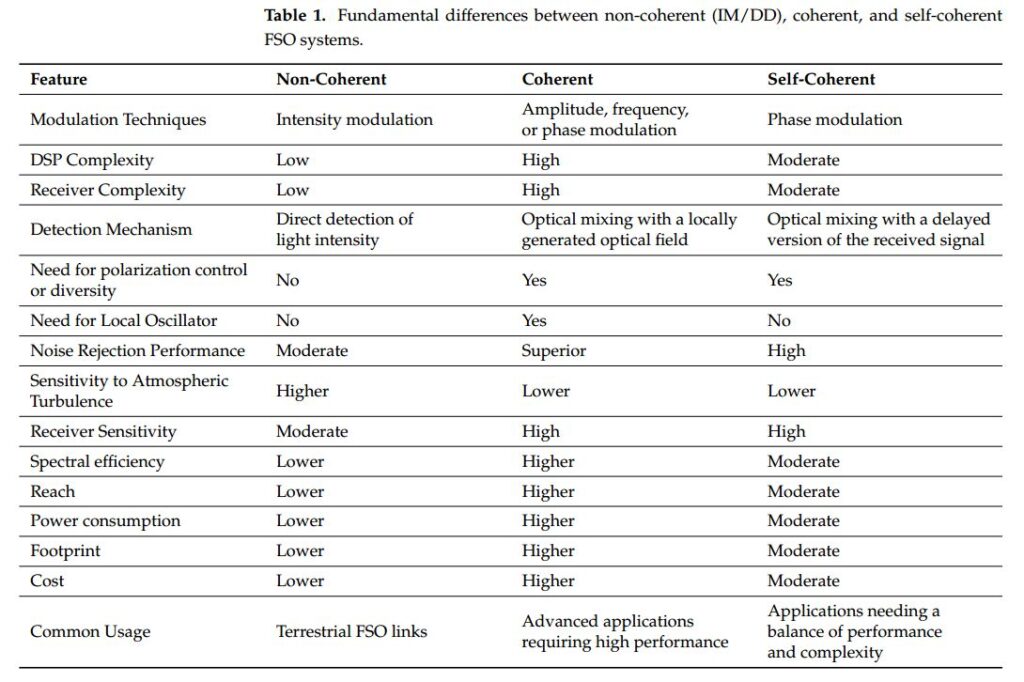
The operation of an FSO system involves three primary components. At the transmitter, a laser diode or LED encodes information onto an optical carrier. The signal then propagates through the free-space channel, where it is influenced by atmospheric effects such as absorption, scattering, turbulence, multipath propagation, and alignment errors. At the receiver, photodetectors convert the incoming optical signal back into an electrical form. Depending on system design, detection techniques may include non-coherent (intensity modulation with direct detection), coherent detection, or self-coherent approaches.
A critical design consideration in FSO systems is the choice of detection technique. Non-coherent systems, typically based on IM/DD, offer simplicity and low implementation cost but are less efficient and more susceptible to turbulence-induced degradation. Coherent systems provide superior sensitivity and spectral efficiency, enabling higher performance, though at the expense of increased complexity, power consumption, and hardware requirements. Self-coherent systems offer a compromise, utilizing phase modulation and delayed self-mixing to achieve improved performance with moderate system complexity.
Selecting an appropriate FSO architecture requires careful consideration of trade-offs among performance, implementation complexity, and environmental conditions. In many cases, hybrid solutions that combine different techniques may provide the most effective balance.
Looking ahead, FSO technology envisions a future where high-speed optical links connect urban infrastructures, enable seamless satellite-to-ground communication, and integrate with RF systems to support next-generation networks such as 6G.