On a dense, misty morning, it is common for nearby buildings to fade from view. While this is only a minor inconvenience in daily life, it represents a serious limitation for Free Space Optics (FSO). When data is transmitted through open air rather than optical fiber, the atmosphere effectively becomes the communication channel—and it is inherently unpredictable.
In FSO systems, the atmosphere is not merely a passive medium. It actively influences signal propagation by altering, distorting, or even completely attenuating the optical beam.
The Atmospheric Challenge
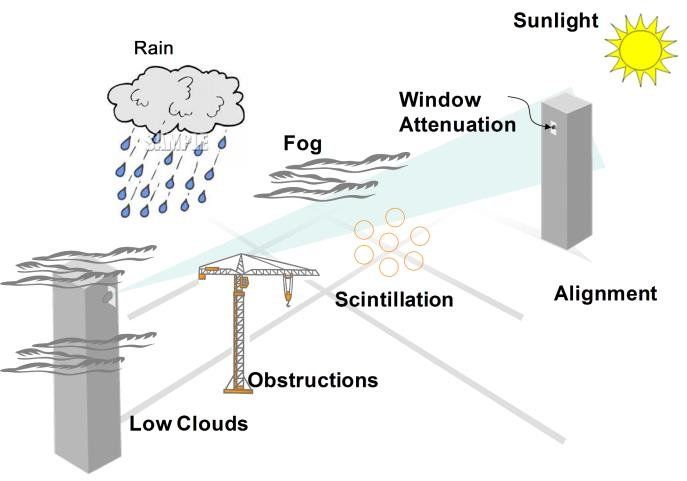
Several environmental factors introduce significant impairments to FSO links:
- Fog
Suspended water droplets cause Mie scattering and absorption of optical energy. This is the most critical impairment for FSO, with attenuation levels ranging from 0.22 to 272 dB/km, depending on density. - Rain and Snow
Intense rainfall, for example at 15 cm/hour, can introduce attenuation in the range of 20–30 dB/km, while heavy snowfall can exceed 60 dB/km under severe conditions. - Atmospheric Turbulence
Variations in temperature and pressure create random fluctuations in air density, leading to phase and amplitude distortions of the optical wave. This results in scintillation, where the received signal exhibits rapid fluctuations. - Aerosols and Gases
Particles such as dust, smoke, and other pollutants scatter and absorb light, reducing the number of photons that successfully reach the receiver.
Impact on System Performance
Atmospheric effects translate directly into system-level degradation:
- Fluctuations in received optical power, including deep fades
- Beam wander and distortion, often described as image instability
- Increased bit error rates (BER), leading to packet loss and reduced throughput
- Temporary or complete link outages under severe weather conditions
Engineering Approaches for Resilience
To ensure reliable operation, modern FSO systems incorporate several mitigation strategies:
- Adaptive Optics
Real-time correction of wavefront distortions using deformable mirrors to counteract turbulence effects. - Hybrid FSO/RF Systems
Integration of radio frequency links as a backup. When optical transmission is impaired, the system switches to RF to maintain high availability. - Diversity Techniques
Use of spatial, angular, or path diversity to ensure that multiple independent propagation paths are available. - Forward Error Correction (FEC)
Advanced coding schemes such as LDPC enable recovery of corrupted data, improving robustness against channel impairments.
The Path Forward
The primary challenge in FSO is not achieving high data rates, but ensuring consistent link availability. Future systems must be capable of adapting dynamically to atmospheric conditions.
This leads to an important research direction: the integration of machine learning for predictive and adaptive control. By leveraging historical and real-time environmental data, it may be possible to anticipate atmospheric disturbances and optimize system parameters proactively. However, whether such approaches can fully eliminate the need for hybrid RF backup in mission-critical systems remains an open question.