A common misconception in free-space optical (FSO) system design is that increasing transmitted power necessarily creates an eye safety hazard. This interpretation is incorrect and often results in systems that are unnecessarily limited in performance.
What IEC 60825 Actually Regulates
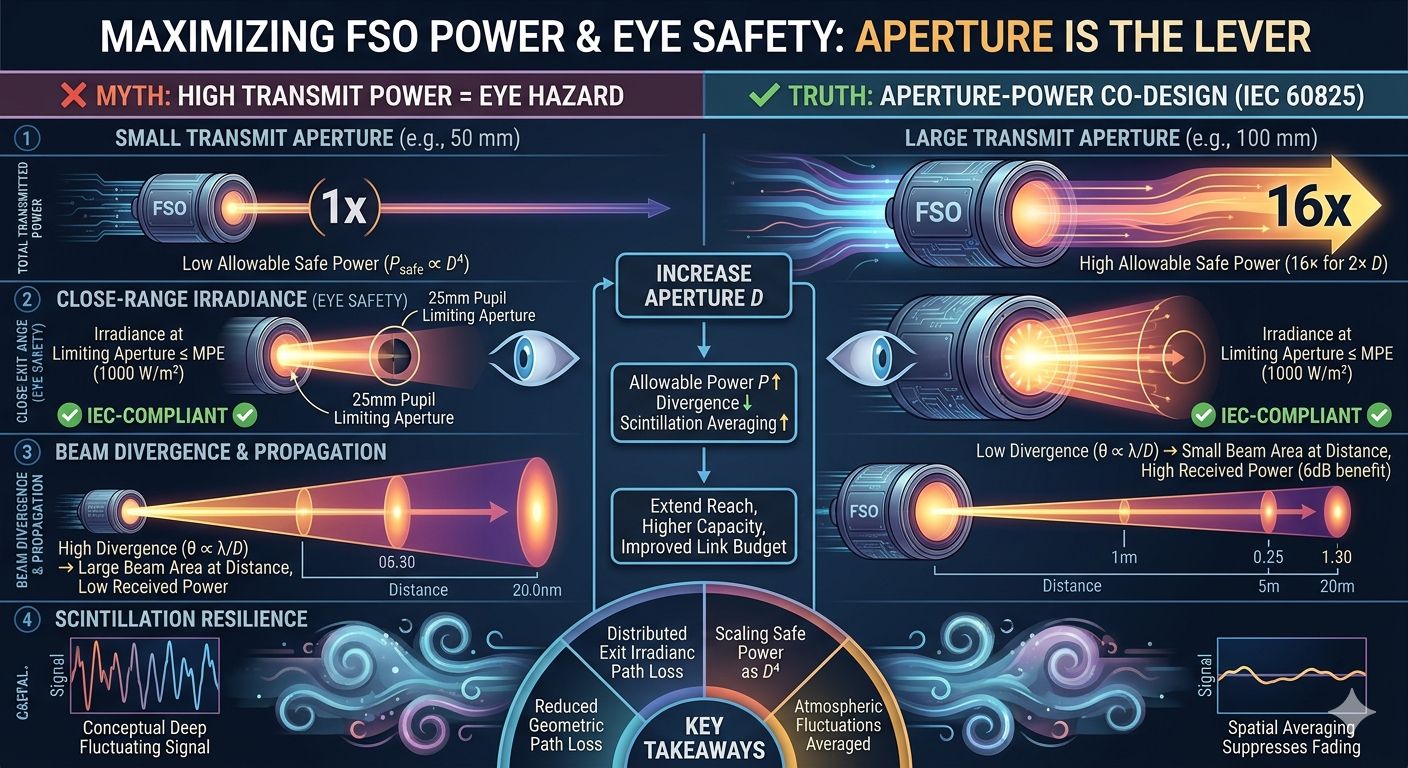
The standard does not impose a limit on total transmitted optical power. Instead, it specifies a limit on irradiance at the cornea, measured in watts per square meter, rather than total emitted watts. For a wavelength of 1550 nm and exposure durations exceeding 10 seconds, the Maximum Permissible Exposure (MPE) at the cornea is 1000 W/m². This parameter defines the relationship between aperture size and allowable transmit power.
Impact of Increasing the Transmit Aperture
- Reduction in Irradiance at the Aperture Plane
When the aperture size increases, the same optical power is distributed over a larger area, reducing irradiance at the source. As a result, the irradiance entering a 25 mm pupil (the IEC-defined limiting aperture at 1550 nm) remains well below the MPE even at short distances. - Decrease in Beam Divergence
Beam divergence is inversely proportional to the beam waist, following the relation θ∼πw0λ. Increasing the aperture reduces divergence, which in turn lowers geometric spreading losses. For example, doubling the aperture reduces divergence by half, corresponding to a 6 dB improvement in link budget, equivalent to a fourfold increase in transmitted power. - Scaling of Allowable Safe Power with Aperture Diameter
The permissible transmit power under eye safety constraints scales with the fourth power of the aperture diameter (D⁴). Doubling the aperture diameter increases the allowable transmit power by a factor of 16, without violating safety limits. This is a direct consequence of the interplay between beam area, divergence, and irradiance. - Improved Resistance to Atmospheric Scintillation
A larger transmit beam averages out turbulence-induced phase distortions across its cross-section. This spatial averaging effect reduces the impact of scintillation and enhances link stability, providing benefits beyond simple power scaling.
Rethinking FSO Power Budgeting
Conventional FSO link design often treats transmit power as a fixed starting point. A more effective approach is to begin with the aperture size and determine the maximum permissible transmit power based on eye safety constraints. From there, the received power, fade margin, and system availability can be evaluated.
The transmit aperture should not be viewed merely as a packaging parameter. It is a fundamental design variable that simultaneously influences power handling, beam divergence, safety compliance, and robustness to atmospheric effects.
Eye safety should not be treated as a strict limitation on transmitted power. Instead, it should be approached as a joint design problem involving both aperture and power. The IEC 60825-12 framework, along with Gaussian beam propagation principles, provides a basis for optimizing system performance. The transmit aperture serves as a key design lever and should be utilized accordingly.