
The exponential growth in mobile data traffic worldwide up to 5016 EB monthly by 2030 underlines the importance of designing communication systems which are far more advanced beyond the capabilities offered by 5G. Although 5G incorporates higher frequency bands like millimeter waves as well as better Quality of Service (QoS), it falls short of being able to accommodate the upcoming requirements of an age where there is full automation in remote operations, use of immersive 3D contents, and the advent of the Internet of Everything (IoE). Thus, the requirement for ultra-reliable and low latency communications with data rate reaching up to 1Tbps along with 1000-fold increase in device capability necessitates 6G. The fundamental feature of 6G will be the unification of communication, sensing, and intelligence through the use of technologies like THz bands, Artificial Intelligence (AI), Reconfigurable Intelligent Surfaces (RIS), and 3D communications.
The high THz frequencies provide high data rates. However, the THz bands need to overcome a significant challenge for data transfer over relatively long distances because of the high propagation loss and atmospheric absorption characteristics [1]. We require a new design for the transceiver architecture for the THz communication systems. The transceiver must be able to operate at high frequencies, and we need to ensure the full use of very widely available bandwidths. A minimal gain and aneffective area of the distinct THz band antennas is another challenge of THz communication. Health and safety concerns related to THz band communications also need to be addressed.
Complexity in Resource Management for 3D Networking: The 3D networking extended in the vertical direction. Hence, a new dimension was added. Moreover, multiple adversaries may intercept legitimate information, which may significantly degrade overall system performance. Therefore, new techniques for resource management and optimization for mobility support, routing protocol, and multiple access are essential. Scheduling needs a new network design.
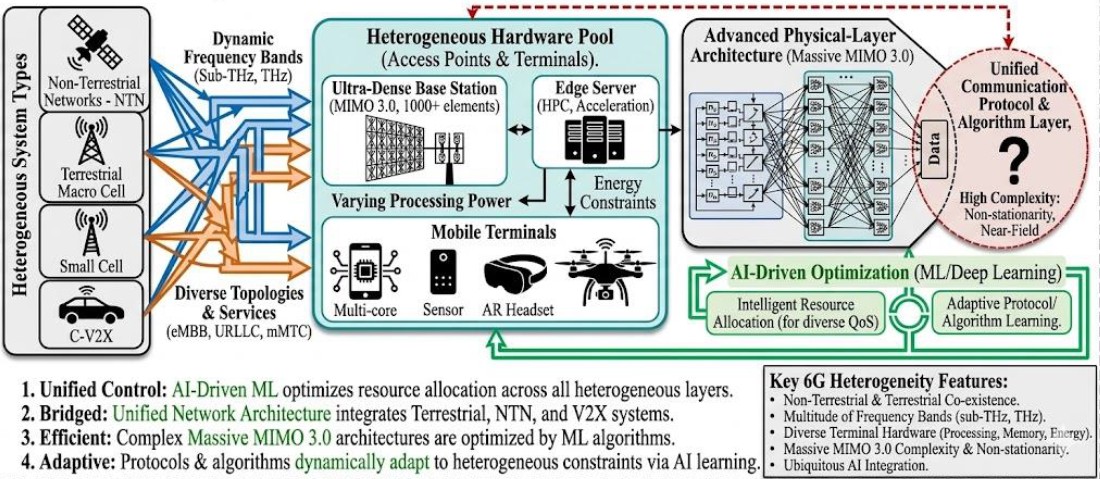
Heterogeneous Hardware Constraints: In 6G, a huge number of heterogeneous types of communication systems, such as frequency bands, communication topologies, service delivery, and so on, will be involved. Moreover, the access points and mobile terminals will be significantly different in the hardware settings. The massive MIMO technique will be further upgraded from 5G to 6G, and this might require a more complex architecture. It will also complicate the communication protocol and algorithm design. However, machine learning and AI will be included in the communication. Moreover, the hardware design for different communication systems is different. Unsupervised and reinforcement learning may create complexities in hardware implementation as well. Consequently, it will be challenging to integrate all the communication systems into a single platform.
Autonomous Wireless Systems: One of the most important aims of 6G technology would be to establish a seamless platform that can serve as the basis for complete automation in applications like automated cars and Industry 4.0 solutions. To make this possible, it will require a very advanced and intricate ‘system of systems’, wherein artificial intelligence, autonomous cloud computing, and many other types of wireless systems come together into one system. The key technical challenge here will be to build a system that will perform better than human-operated systems.
Modeling of Sub-mmWave (THz) Frequencies: The propagation characteristics of the mmWave and sub-mmWave (THz) is subject to atmospheric conditions; therefore, absorptive and dispersive effects are seen.1 Climatic conditions change frequently and are, therefore, highly unpredictable. Thus, the channel modeling of this band is relatively complex, and this band does not have any perfect channel model.
Device Capability: The 6G system will provide several new features. Devices, such as smartphones, should have the ability to cope with the new features. In particular, it is challenging to support Tbps throughput, AI and integrated sensing with communication features using individual devices. The 5G devices may not support a few of the 6G features, and the capability improvement in 6G devices may increase the cost as well. The number of devices for 5G is expected to be billions. When communication infrastructure moves from 5G to 6G, the compatibility of those 5G devices to 6G is a critical issue. This compatibility makes it easier for end-users to use and saves a lot of money. Therefore, 6G needs to prioritize integrated communications-computing devices, computing performance improvement, and so on based on technological compatibility with 5G.
Spectrum and Interference Management: Due to the scarcity of the spectrum resources and interference issues, it is essential to efficiently manage the 6G spectra, including the spectrum-sharing strategies and innovative spectrum management techniques. Efficient spectrum management is necessary for achieving the maximum resource utilization with QoS maximization. At 6G, researchers need to address concerns such as how to share spectrum and how to manage spectrum mechanisms in heterogeneous networks that synchronize transmissions on the same frequency. Researchers also need to investigate how the interference can be cancelled using the standard interference cancellation methods, such as parallel interference cancellation, and successive interference cancellation.
The move to 6G is a paradigm change that needs to address many challenges posed by electromagnetics and architecture. While the use of THz frequencies offers the necessary bandwidth for 1 Tbps transmission and IoE, there are serious propagation issues such as excessive path loss and absorption that need to be addressed through the implementation of technologies such as RIS and beamforming, as well as a more sophisticated understanding of Electromagnetic and Information Theories in order to address existing modeling shortcomings.