
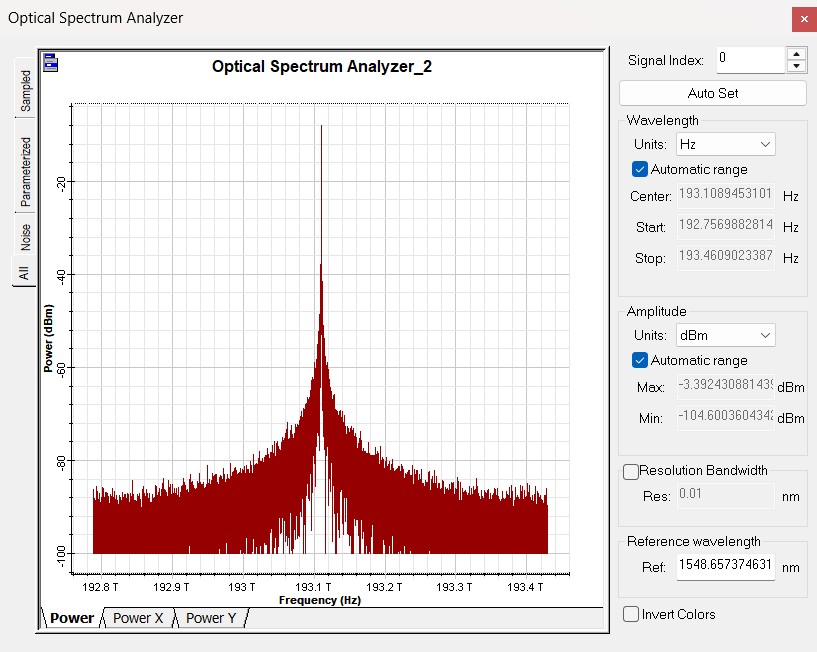
Optical Single Sideband Suppressed Carrier (SSB-SC) modulation is a modulation technique in which an optical carrier is suppressed, and only a single sideband (either the upper or the lower) of the modulated spectrum is transmitted.
How it works
The optical spectrum consists of a single narrow band, reducing redundancy..
Input Source
A narrow-linewidth continuous-wave (CW) laser provides the optical carrier.
External Modulator
A Mach–Zehnder Modulator (MZM) or IQ modulator driven by an RF or baseband electrical signal generates sidebands.
Suppression of Carrier & One Sideband
Proper biasing of the modulator suppresses the carrier.
Using optical filters (or modulation techniques such as Hilbert transform in an IQ modulator), one of the sidebands is removed.
Resulting Spectrum
Only one sideband remains, carrying the full information.
Key Features
- Bandwidth efficiency: Only one sideband is transmitted, halving the required bandwidth compared to DSB.
- Suppressed carrier: Power is not wasted on an unmodulated carrier.
- Dispersion tolerance: Optical SSB modulation is more resilient to chromatic dispersion compared to DSB, since overlapping sidebands that cause signal fading are avoided.
Advantages
- Higher spectral efficiency compared to conventional DSB.
- Reduced power consumption — no carrier transmission.
- Better long-haul performance — mitigates fiber dispersion effects.
Challenges
- Complex generation — requires precise biasing, phase control, or optical filtering.
- Receiver complexity — carrier recovery or coherent detection is often needed.
Applications in Optical Communication
Microwave photonics — efficient optical representation of RF signals..
Radio-over-Fiber (RoF) systems — efficient transport of RF signals over optical links.
High-capacity WDM systems — saves bandwidth and reduces crosstalk.
Long-haul optical transmission — improved dispersion performance compared to DSB.